Do Uber Drivers Pay Self-Employment Tax? Rates, Examples and How to Lower It
Why rideshare and delivery drivers owe 15.3% self-employment tax, how it is calculated on Schedule SE, what it costs at different profit levels and the legal ways to reduce it.
Listen to this article
Key takeaways
- Yes. Uber drivers and Uber Eats couriers are self-employed and owe 15.3% self-employment tax on 92.35% of their net profit.
- It applies once your net earnings from self-employment reach $400, even if you owe no income tax.
- The 12.4% Social Security part stops at the 2026 wage base of $184,500; the 2.9% Medicare part has no limit.
- Only business expenses (mileage, fees, phone) reduce it. The standard deduction, QBI and the new tips deduction do not.
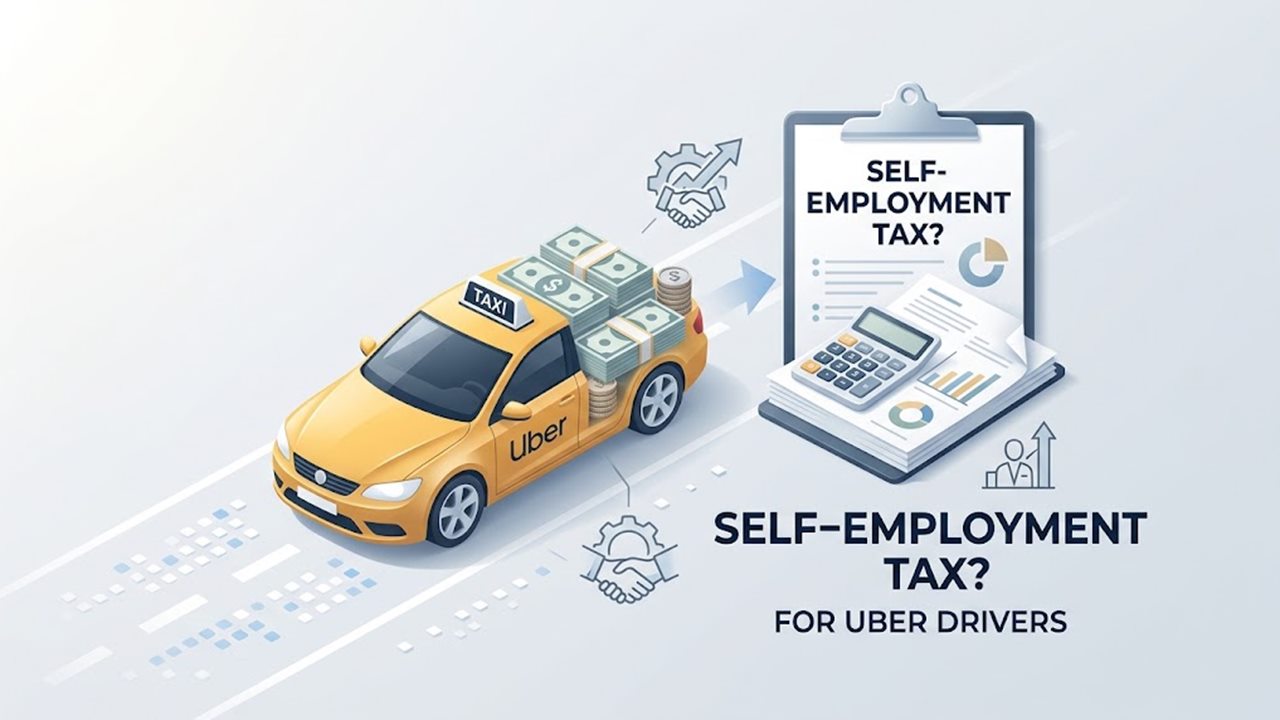
When you work for an employer, your paycheck shows Social Security and Medicare withholding, and your employer pays a matching amount you never see. As an Uber driver you are both employee and employer, so you pay both halves yourself. That is the self-employment tax, and for many drivers it is a larger bill than federal income tax.
Please note
General information about US federal rules for 2026, as of October 2026; not tax advice.
What self-employment tax is
Self-employment (SE) tax funds Social Security and Medicare for people who work for themselves. It has two parts:
| Part | Rate | Applies to (2026) |
|---|---|---|
| Social Security | 12.4% | Net SE earnings up to $184,500, reduced by any W-2 wages |
| Medicare | 2.9% | All net SE earnings |
| Additional Medicare tax | 0.9% | Combined wages and SE earnings above $200,000 (single) or $250,000 (married filing jointly) |
Uber does not withhold any of this. You calculate it on Schedule SE and pay it with your return or through quarterly estimated taxes.
How it is calculated
SE tax = Net profit × 92.35% × 15.3%
The 92.35% factor mirrors the fact that employees do not pay tax on the employer's half of these taxes. In practice, SE tax is about 14.1% of your net profit. Your net profit is the figure from Schedule C: earnings minus Uber's fees, mileage or car costs and other business expenses.
What it costs at different profit levels
| Net profit from driving | Self-employment tax |
|---|---|
| $5,000 | $706 |
| $10,000 | $1,413 |
| $20,000 | $2,826 |
| $30,000 | $4,239 |
| $50,000 | $7,065 |
Unlike income tax, SE tax has no standard deduction and no zero bracket. A part-time driver with low income can owe no income tax at all and still owe several hundred dollars in SE tax.
Example: a full-time driver
Example
A driver earns $40,000 after Uber's fees and deducts $13,365 for 18,000 business miles plus $1,030 for phone and supplies. Net profit is $25,605. SE tax: $25,605 × 92.35% × 15.3% = $3,618. Federal income tax for this single driver comes to only about $376, so SE tax makes up around 90% of the federal bill. Without any deductions, SE tax on $40,000 would be about $5,650.
The full calculation is in our Uber driver tax guide.
Drivers who also have a W-2 job
The 12.4% Social Security part only applies up to the annual wage base. Your W-2 wages count first. If you earn $190,000 in salary in 2026, you have already passed the $184,500 limit, so your Uber profit only pays the 2.9% Medicare part (plus the 0.9% additional Medicare tax above the threshold). For most drivers with ordinary salaries, the full 15.3% still applies to their driving profit.
What reduces self-employment tax, and what doesn't
| Deduction | Reduces SE tax? |
|---|---|
| Mileage or actual car expenses | Yes |
| Uber service and booking fees | Yes |
| Phone, supplies, tolls, parking | Yes |
| Half of SE tax (adjustment to income) | No, only income tax |
| Standard deduction | No |
| QBI deduction (up to 20%) | No |
| Deduction for qualified tips (2025–2028) | No |
| SEP IRA or solo 401(k) contributions | No, only income tax |
| Self-employed health insurance | No, only income tax |
That is why a careful mileage log matters so much: business deductions are the only way to lower both taxes at once. See all Uber driver tax deductions.
What about forming an LLC or S corporation?
A single-member LLC changes nothing for SE tax on its own; it is still taxed like a sole proprietorship. An LLC or corporation that elects S corporation status can pay you a reasonable salary and distribute the rest of the profit without SE tax. However, that requires payroll, a separate business tax return and extra costs, and Uber pays the individual driver account. For typical rideshare profits it rarely pays off; discuss it with a tax professional before setting one up.
The upside: Social Security credits
SE tax is not just a cost. It counts toward your Social Security record. In 2026 you earn one credit for every $1,890 of covered earnings, up to four credits a year, and you generally need 40 credits to qualify for retirement benefits. Your earnings also determine the size of your future benefit and protect your eligibility for disability benefits.
Frequently asked questions
Do Uber drivers pay self-employment tax?
Yes. Rideshare and delivery drivers who are independent contractors pay 15.3% SE tax on 92.35% of their net profit if their net earnings are $400 or more.
Is self-employment tax on top of income tax?
Yes. You pay SE tax and regular federal income tax. Half of the SE tax is deductible when calculating your income tax.
Do Uber Eats drivers pay self-employment tax?
Yes. Uber Eats couriers are self-employed in the same way and pay the same SE tax on their delivery profit.
Are tips subject to self-employment tax?
Yes. Tips are business income. The new tips deduction lowers income tax only, not SE tax.
Do I pay self-employment tax if I made less than $400?
No. If your net earnings from self-employment are less than $400 for the year, you do not owe SE tax. You may still need to file for other reasons; see do I need to file taxes for Uber?