Paycheck Tax Calculator: Estimate Your 2026 Take-Home Pay
Estimate the federal income tax, Social Security and Medicare taken from each paycheck in 2026 and see your take-home pay, with the brackets, standard deduction and limits of the estimate explained.
Listen to this article
Key takeaways
- Three federal taxes come out of most paychecks: federal income tax, Social Security (6.2% of wages up to $184,500 in 2026) and Medicare (1.45%, plus 0.9% on wages above $200,000).
- A single filer paid $2,500 every two weeks keeps about $2,092.60 per paycheck after federal taxes in this estimate, before any state income tax.
- Pre-tax 401(k) contributions lower federal income tax but not Social Security and Medicare; Section 125 health premiums lower both.
- This is an estimate. Your employer uses IRS Publication 15-T and your Form W-4, and nine states have no wage income tax while the rest add their own.
Your salary and your paycheck are two different numbers. Before the money reaches your account, your employer withholds federal income tax and FICA taxes, plus any state or local tax and your benefit deductions. This paycheck tax calculator estimates the federal part for 2026 so you can see roughly what you will take home, compare a raise or a new job offer, or check whether your withholding looks reasonable.
Paycheck tax calculator
An estimate of 2026 federal taxes from IRS brackets and the standard deduction, assuming this is your only job and the same pay all year. Your employer withholds with IRS Publication 15-T and your Form W-4, so the actual paycheck can differ. State and local income tax is only included as the flat rate you enter.
What the calculator includes and what it does not
The estimate annualizes your pay, subtracts pre-tax deductions and the 2026 standard deduction for your filing status, applies the 2026 federal brackets and the child tax credit, then divides the result by your number of paychecks. Social Security and Medicare are calculated on your wages after Section 125 deductions.
State and local income taxes are included as a flat rate you enter, applied to your pay after pre-tax deductions. Real state taxes use their own brackets, deductions and credits, and nine states do not tax wages at all: Alaska, Florida, Nevada, New Hampshire, South Dakota, Tennessee, Texas, Washington and Wyoming. After-tax deductions such as Roth 401(k) contributions or union dues are subtracted at the end.
The estimate does not include other income such as a second job or investments, itemized deductions, other credits, or the new 2025–2028 deductions for qualified tips (up to $25,000), qualified overtime pay (up to $12,500, or $25,000 for joint filers) and the additional $6,000 deduction for people 65 and older. Those reduce your tax when you file and can be reflected in withholding through Form W-4. Bonuses and commissions paid separately are often withheld at a flat 22% federal rate instead; the bonus tax calculator shows what such a check leaves you.
The taxes taken out of a paycheck
Federal income tax
Withholding is designed to match your yearly income tax. It depends on your pay, filing status and the entries on your Form W-4, including dependents (Step 3), other income and deductions (Step 4) and any extra amount you ask to have withheld. Employers calculate it with the tables in IRS Publication 15-T, which are built on the same brackets and standard deduction used here.
Social Security
6.2% of wages up to the 2026 wage base of $184,500. Above that, Social Security tax stops for the rest of the year. Your employer pays another 6.2%.
Medicare
1.45% of all wages with no cap. Employers must also withhold an additional 0.9% on wages above $200,000 in a calendar year, regardless of filing status; the actual liability threshold is $250,000 for joint filers, and any difference is settled on your tax return.
State and local income tax
Nine states do not tax wages: Alaska, Florida, Nevada, New Hampshire, South Dakota, Tennessee, Texas, Washington and Wyoming. Most others take a flat or graduated percentage, and some cities and counties add their own tax. Check your state revenue department for its withholding tables.
2026 federal tax brackets
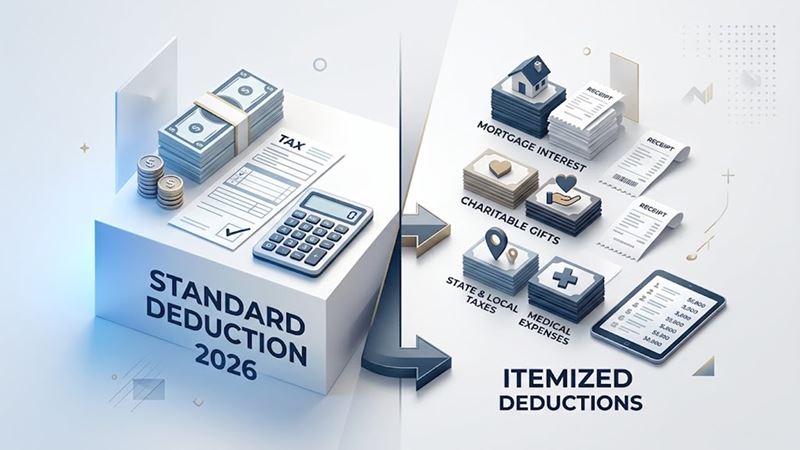
The rates apply to taxable income, which is income after the standard or itemized deduction. For 2026 the standard deduction is $16,100 for single filers, $32,200 for married couples filing jointly and $24,150 for heads of household.
| Rate | Single | Married filing jointly | Head of household |
|---|---|---|---|
| 10% | $0 – $12,400 | $0 – $24,800 | $0 – $17,700 |
| 12% | $12,401 – $50,400 | $24,801 – $100,800 | $17,701 – $67,450 |
| 22% | $50,401 – $105,700 | $100,801 – $211,400 | $67,451 – $105,700 |
| 24% | $105,701 – $201,775 | $211,401 – $403,550 | $105,701 – $201,750 |
| 32% | $201,776 – $256,225 | $403,551 – $512,450 | $201,751 – $256,200 |
| 35% | $256,226 – $640,600 | $512,451 – $768,700 | $256,201 – $640,600 |
| 37% | Over $640,600 | Over $768,700 | Over $640,600 |
Only the income inside each band is taxed at that band's rate. Moving into a higher bracket never reduces your take-home pay; it only raises the tax on the next dollars. Tax brackets explained walks through this with examples.
Example: $2,500 every two weeks, single
| Step | Amount |
|---|---|
| Annual gross pay ($2,500 × 26) | $65,000 |
| Minus 2026 standard deduction | −$16,100 |
| Taxable income | $48,900 |
| Income tax: 10% of $12,400 + 12% of $36,500 | $5,620 |
| Per paycheck | Amount |
|---|---|
| Gross pay | $2,500.00 |
| Federal income tax ($5,620 ÷ 26) | −$216.15 |
| Social Security (6.2%) | −$155.00 |
| Medicare (1.45%) | −$36.25 |
| Take-home pay before state tax and benefits | $2,092.60 |
If the same worker puts $150 per paycheck into a traditional 401(k) and pays $100 in pre-tax health premiums, federal income tax falls to $186.15, Social Security to $148.80 and Medicare to $34.80. Take-home pay drops by only about $212, to $1,880.25, even though $250 more goes to savings and insurance.
Example: married couple with two children
A married couple filing jointly, paid $5,000 twice a month ($120,000 a year) with two children under 17: taxable income is $87,800 and the income tax before credits is $10,040. The child tax credit of $2,200 per child cuts it to $5,640 for the year, or $235 per paycheck. With Social Security of $310 and Medicare of $72.50, take-home pay is about $4,382.50 per paycheck.
Ways to change your take-home pay
- Update your Form W-4 after a marriage, a new child, a second job or a large change in income. The IRS Tax Withholding Estimator helps you fill it in.
- Use pre-tax benefits. Traditional 401(k) contributions (up to $24,500 in 2026), HSA contributions and Section 125 health premiums lower your taxable pay.
- Avoid a big refund or bill. A large refund means you lent the government money interest-free; a large balance due can trigger an underpayment penalty. If you also have freelance income, read quarterly estimated taxes.
- Compare deductions. Most people take the standard deduction; see standard deduction vs. itemized to check whether itemizing would lower your tax.
If your withholding is far off, adjust it with a new W-4. Most refunds arrive within about three weeks with e-file and direct deposit; see the tax refund timeline.
Frequently asked questions
How much tax is taken out of a $1,000 paycheck?
For a single filer paid weekly ($52,000 a year) with no pre-tax deductions, about $78 of federal income tax, $62 of Social Security and $14.50 of Medicare, leaving roughly $845 before state tax. Use the calculator for your own pay and status.
Why is my paycheck different from the calculator?
Your employer uses your exact W-4 entries and the Publication 15-T tables, and may deduct state tax, benefits, retirement contributions or wage garnishments. Bonuses are often withheld at a flat 22% federal rate.
What is the Social Security wage base for 2026?
$184,500. Wages above that are not subject to the 6.2% Social Security tax, but Medicare tax continues on all wages.
Does a 401(k) contribution reduce Social Security tax?
No. Traditional 401(k) contributions reduce federal and most state income tax, but Social Security and Medicare are still due on that money.
Is the child tax credit included in withholding?
Only if you claim it in Step 3 of your Form W-4. This calculator includes up to $2,200 per qualifying child under 17 for 2026, reduced at higher incomes.
Sources