Standard Deduction vs. Itemized Deductions: Which Should You Take?
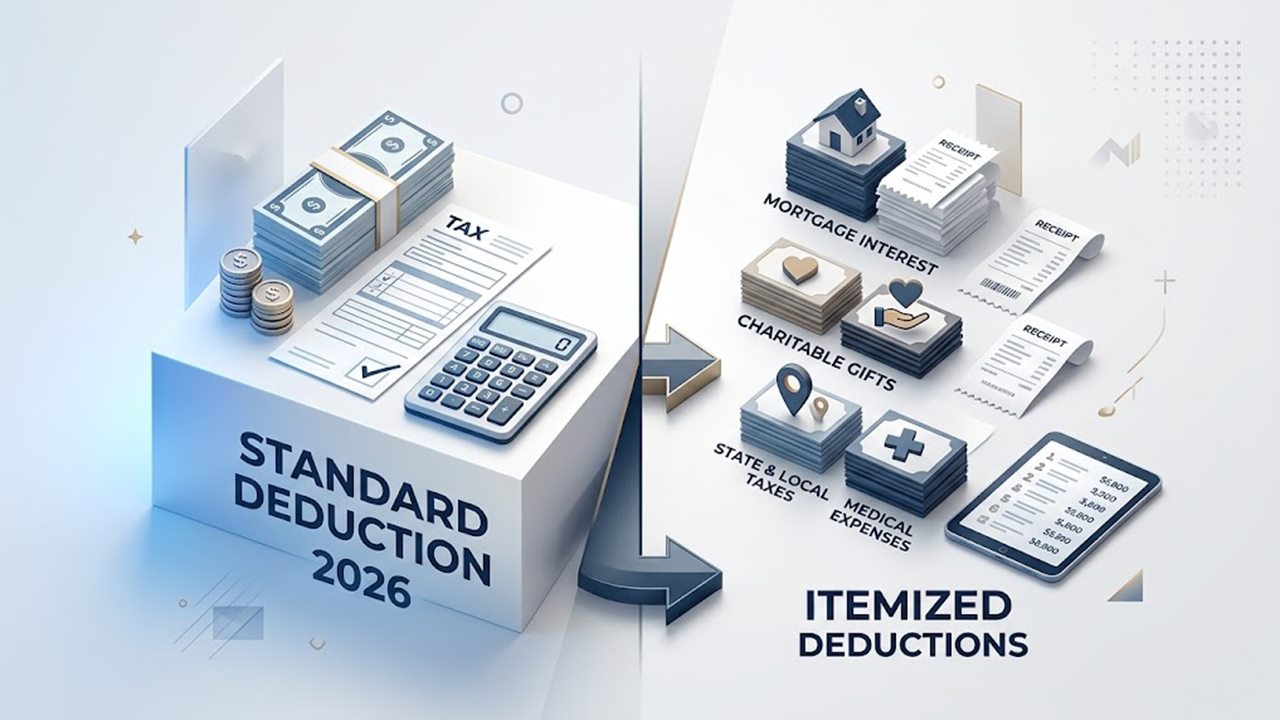
The 2026 standard deduction amounts, which expenses you can itemize under the new rules, worked examples for single and married filers, the bunching strategy and the deductions you can take either way.
Listen to this article
Key takeaways
- 2026 standard deduction: $16,100 single or married filing separately, $32,200 married filing jointly, $24,150 head of household.
- Itemize only when mortgage interest, state and local taxes (capped at $40,400 in 2026, lower at very high incomes), charitable gifts and other deductions add up to more.
- New for 2026: non-itemizers can deduct up to $1,000 ($2,000 joint) of cash gifts to charity, while itemizers' charitable deductions start above 0.5% of AGI.
- "Bunching" deductions into alternating years can let you itemize one year and take the standard deduction the next.
Every taxpayer gets to subtract either the standard deduction or the total of their itemized deductions from income, whichever is larger. Since the standard deduction roughly doubled in 2018, most households take it. But homeowners in high-tax states, large charitable givers and people with big medical bills can still come out ahead by itemizing, and the 2025 tax law changed several of the rules for 2026.
2026 standard deduction amounts
| Filing status | Standard deduction | Additional amount if 65+ or blind (each) |
|---|---|---|
| Single | $16,100 | $2,050 |
| Married filing jointly | $32,200 | $1,650 |
| Head of household | $24,150 | $2,050 |
| Married filing separately | $16,100 | $1,650 |
From 2025 through 2028, people 65 and older can also claim a separate deduction of up to $6,000 each, which phases out above $75,000 of modified adjusted gross income ($150,000 for joint filers). It is available whether you itemize or not.
What you can itemize in 2026
| Deduction | Key 2026 rules |
|---|---|
| State and local taxes (SALT) | Income or sales tax plus property tax, capped at $40,400 ($20,200 if married filing separately); the cap shrinks for modified AGI above $505,000, but not below $10,000 |
| Mortgage interest | Interest on up to $750,000 of acquisition debt on a main and second home; see mortgage interest deduction 2026 |
| Mortgage insurance premiums | Deductible again from 2026, phasing out above $100,000 of AGI |
| Charitable contributions | Generally only the part above 0.5% of AGI counts for itemizers from 2026 |
| Medical and dental expenses | Only the part above 7.5% of AGI |
| Casualty and theft losses | Generally limited to federally declared disasters |
For taxpayers in the top 37% bracket, the 2025 law also caps the tax value of itemized deductions at 35 cents per dollar starting in 2026.
Example 1: single homeowner
| Item | Amount |
|---|---|
| Mortgage interest | $9,000 |
| State income and property taxes | $7,000 |
| Charity $1,500, minus 0.5% of $80,000 AGI ($400) | $1,100 |
| Total itemized | $17,100 |
| Standard deduction | $16,100 |
Itemizing deducts $1,000 more. In the 22% bracket, that saves about $220 in federal tax.
Example 2: married couple
A couple with $150,000 of AGI pays $18,000 of mortgage interest and $12,000 of state and local taxes and gives $3,000 to charity. After the 0.5% floor ($750), the charitable deduction is $2,250, for a total of $32,250, just $50 above the $32,200 standard deduction. Itemizing barely pays, which is exactly the situation where bunching helps.
The bunching strategy
If your itemized deductions hover near the standard deduction, concentrate them in alternate years. For example, the couple above could make two years of charitable gifts in one December, through a donor-advised fund if they want the money distributed over time, and pay the January property tax installment before year-end if their county allows it. In the bunched year they itemize well above $32,200; in the next year they take the standard deduction. Over two years the total deduction is higher than taking the standard deduction twice.
Deductions you get either way
Some tax breaks are "above the line" or separate from the itemized list, so you get them with the standard deduction too:
- Traditional IRA, 401(k) and HSA contributions
- Student loan interest (up to $2,500, subject to income limits)
- Half of self-employment tax and the self-employed health insurance deduction; see self-employment tax
- From 2026, up to $1,000 ($2,000 joint) of cash gifts to qualifying charities for non-itemizers
- For 2025 through 2028, the deductions for qualified tips, qualified overtime pay and the $6,000 senior deduction
How the choice affects your tax
A deduction lowers taxable income, so its value equals the deduction times your marginal rate: $1,000 more in deductions saves $220 in the 22% bracket and $120 in the 12% bracket. Tax brackets explained shows how marginal rates work, and the paycheck tax calculator uses the 2026 standard deduction to estimate withholding.
Once you know your deduction, you can estimate when your money arrives with the tax refund timeline, and an HSA contribution lowers taxable income whichever way you file; see health savings accounts.
Frequently asked questions
What is the standard deduction for 2026?
$16,100 for single filers and married filing separately, $32,200 for married couples filing jointly and $24,150 for heads of household, plus extra amounts for people 65 or older or blind.
Should I itemize or take the standard deduction?
Add up your deductible mortgage interest, state and local taxes (up to the cap), charitable gifts above the floor and medical costs above 7.5% of AGI. If the total exceeds your standard deduction, itemize.
Can I take the standard deduction and still deduct charity?
From 2026, yes: non-itemizers can deduct up to $1,000 of cash contributions to qualifying charities, or $2,000 for married couples filing jointly.
If my spouse itemizes, can I take the standard deduction?
Not if you file separately: when one spouse itemizes, the other must itemize too. Filing jointly avoids the issue.
Is mortgage interest still worth itemizing?
For many homeowners it is not enough on its own, because the standard deduction is large. It matters most with large loans, high state and local taxes or significant charitable giving.