Dollar-Cost Averaging vs. Lump-Sum Investing
What dollar-cost averaging and lump-sum investing are, what Vanguard's research found about which performs better, worked examples in rising and falling markets, and how to decide what to do with a windfall.
Listen to this article
Key takeaways
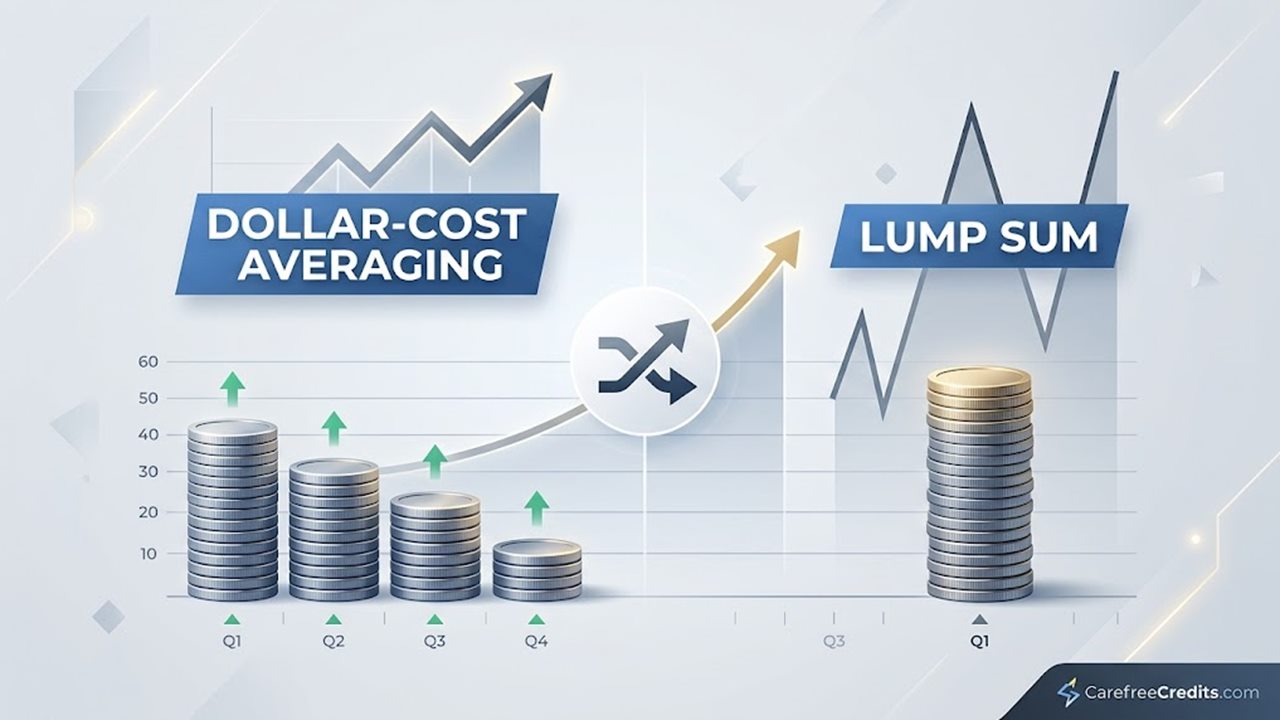
- Lump sum means investing all the money at once; dollar-cost averaging (DCA) means investing it in equal parts over time.
- Vanguard's 2023 research found that investing immediately beat a 12-month cost-averaging plan in about 68% of historical periods, because markets rise more often than they fall.
- DCA wins when prices fall after you start, and it can make it easier to invest a large sum without fear of bad timing.
- Regular contributions from each paycheck are a form of DCA by necessity, and they work well.
You have a lump of cash to invest: a bonus, an inheritance, the proceeds from a home sale or savings that have been sitting idle. Should you invest it all today or spread it out over several months? The math and the psychology point in slightly different directions, and both matter.
The two approaches
| Lump sum | Dollar-cost averaging | |
|---|---|---|
| How it works | Invest the full amount immediately | Invest equal amounts at regular intervals, for example monthly over 6 to 12 months |
| Time in the market | Maximum | Part of the money waits in cash |
| Historical result | Higher return most of the time | Lower return most of the time, but better when prices fall |
| Risk of bad timing | All money exposed to a drop right after investing | Spread across several prices |
| Emotional ease | Harder for many people | Easier; reduces regret |
What the research says
Vanguard's 2023 study, "Cost averaging: Invest now or temporarily hold your cash?", looked at rolling periods from 1976 to 2022 in the United States, the United Kingdom and Australia. Investing a lump sum immediately outperformed cost averaging over 12 months about 68% of the time, measured after one year, across different stock and bond mixes. The reason is straightforward: over that period, stocks outperformed cash about three-quarters of the time, so money waiting to be invested usually missed out on gains. DCA came out ahead mainly in periods when markets declined after the start.
Worked examples: $12,000 into a stock fund
Lump sum: buy 120 shares at $100 in month one. DCA: invest $1,000 at the start of each month for 12 months. Hypothetical prices:
| Market path | DCA average cost per share | Value after 12 months, DCA | Value after 12 months, lump sum |
|---|---|---|---|
| Steady rise from $100 to $122 | $110.57 | $13,241 | $14,640 |
| Dip to $85, recovery to $115 | $99.55 | $13,862 | $13,800 |
| Steady fall from $100 to $74 | $84.16 | $10,551 | $8,880 |
In a rising market, the lump sum wins clearly. After a dip and recovery, the two end up close. In a falling market, DCA loses less. Notice one feature of DCA: because a fixed dollar amount buys more shares when prices are low, the average cost per share is always at or below the average price over the period. That is helpful, but it does not make up for missing a rising market.
When dollar-cost averaging makes sense
- You would not invest otherwise. If fear of a crash keeps you in cash for years, a 6- to 12-month DCA plan that gets you invested beats waiting indefinitely.
- The amount is large relative to your wealth, and a drop right after investing would be hard to live with.
- You are investing from income. Contributions from each paycheck into a 401(k) or IRA are DCA by default, and that is fine.
If you do use DCA, set it up as automatic purchases on fixed dates and keep the waiting cash in a high-yield savings account or money market fund so it earns interest in the meantime. Keep the schedule short; 6 to 12 months is common.
When a lump sum makes more sense
- Your time horizon is long, 10 years or more.
- The money goes into a diversified portfolio, not a single stock.
- You have an emergency fund and will not need to sell after a decline.
- You are confident you will stay invested if the market falls 20% next month.
A middle path
Some investors put half in immediately and dollar-cost average the rest over a few months. Others reduce the risk of a lump sum through the mix rather than the timing, by holding bonds alongside stocks, as in a three-fund portfolio. Both are reasonable; the worst choice is leaving the money uninvested for years while waiting for the "right" moment.
Common mistakes
- Stopping DCA purchases when prices fall, which defeats the purpose.
- Trying to time the market by waiting for a correction that may not come.
- Spreading the money over years, which leaves too much in cash for too long.
- Ignoring taxes and fees. Use tax-advantaged accounts first and commission-free funds.
New to investing? Start with how to start investing or how to invest your first $1,000.
Frequently asked questions
Is dollar-cost averaging a good strategy?
It is a good discipline for investing from income and a reasonable way to invest a windfall if it helps you stay invested. On average, though, investing a lump sum immediately has produced higher returns.
How long should I dollar-cost average a lump sum?
Common schedules run 6 to 12 months. Longer schedules keep more money in cash and lower expected returns.
Does dollar-cost averaging work in a bear market?
Yes, that is when it helps most: each purchase buys more shares at lower prices, which pays off when the market recovers.
Is DCA the same as investing every paycheck?
The mechanics are the same. The difference is that with a paycheck you have no lump sum to invest, so regular investing is simply the only option.
Does DCA reduce risk?
It reduces the risk of investing everything right before a drop, but it also lowers expected returns because part of the money waits in cash.