How Credit Card Interest Is Calculated, Step by Step
APR, daily periodic rate, average daily balance and the grace period, explained with real numbers.
Key takeaways
- Card issuers convert the APR into a daily rate and charge it on your average daily balance.
- If you pay the full statement balance by the due date, you usually pay no interest on purchases.
- Cash advances typically have no grace period, a higher APR and an extra fee.
- Paying only the minimum can stretch a small balance over years and multiply the interest.
Credit card interest feels mysterious because it is rarely shown as a simple monthly percentage. In reality the calculation follows a clear set of steps. Once you understand them, you can predict your interest charge and, more importantly, avoid it.
Step 1: From APR to a daily rate
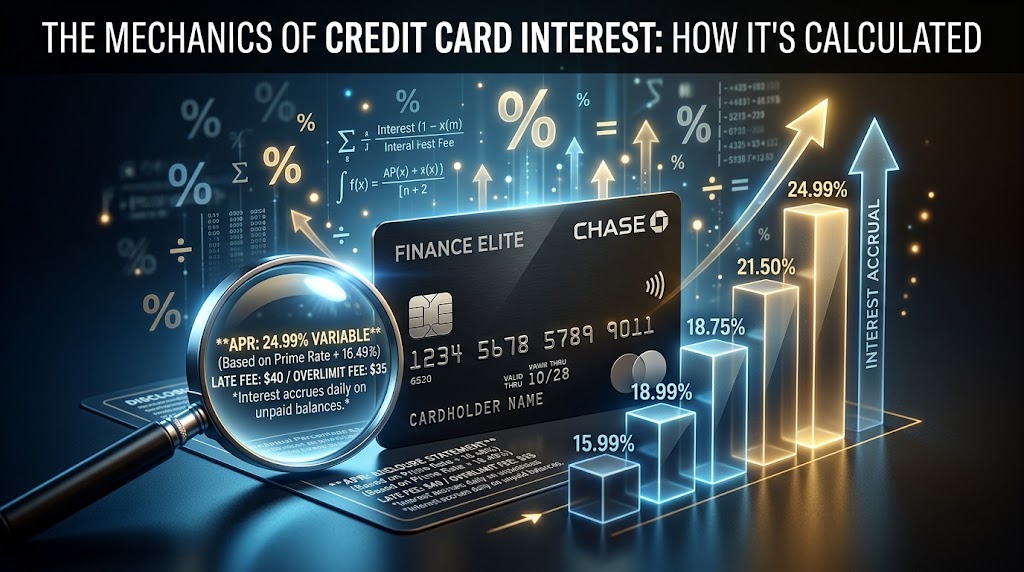
Your card's APR (annual percentage rate) is the yearly cost of carrying a balance. Most issuers divide it by 365 (some use 360) to get the daily periodic rate:
Daily periodic rate = APR ÷ 365
With a 24% APR, the daily rate is 0.24 ÷ 365 ≈ 0.0658% per day.
Many cards have several APRs at once: one for purchases, a higher one for cash advances, possibly a promotional rate for balance transfers, and a penalty APR that can apply after a late payment.
Step 2: The average daily balance
Most issuers use the average daily balance method. They add up your balance at the end of each day in the billing cycle and divide by the number of days. New purchases raise the balance from the day they post; payments lower it from the day they are credited.
That is why paying earlier in the cycle, even before the due date, reduces your interest if you carry a balance.
Step 3: Interest for the billing cycle
Interest = Average daily balance × Daily periodic rate × Days in the cycle
Example
Your average daily balance is $2,000, your APR is 24% and the billing cycle has 30 days: $2,000 × 0.000658 × 30 ≈ $39.45 in interest for that month.
Many issuers compound daily, which means each day's interest is added to the balance used for the next day. The effect is small within one month but adds up when a balance is carried for a long time.
The grace period: how to pay zero interest
Most cards offer a grace period on purchases: the time between the end of the billing cycle and the payment due date. If you pay your full statement balance by the due date, no interest is charged on those purchases. In the US, issuers must deliver your statement at least 21 days before the payment is due.
The catch: if you carry any balance from one month to the next, you typically lose the grace period. New purchases then start accruing interest from the day they post, until you have paid the balance in full again (sometimes for two consecutive cycles).
Cash advances, balance transfers and penalty rates
- Cash advances (withdrawing cash with your credit card) usually have no grace period, carry a higher APR and come with a fee, often 3% to 5% of the amount.
- Balance transfers may offer an introductory APR as low as 0% for a limited time, usually for a transfer fee. When the promotion ends, the regular APR applies to any remaining balance.
- Penalty APRs can apply after a late or returned payment and may be far higher than your normal rate.
- Foreign transaction fees of around 3% apply to purchases in other currencies on many cards. See our guide to exchange rates and currency fees.
What minimum payments really cost
The minimum payment keeps your account in good standing, but it is designed to keep you in debt for a long time. Consider a $2,000 balance at 24% APR with no new purchases:
| Monthly payment | Time to pay off | Total interest |
|---|---|---|
| $60 | 56 months | $1,329 |
| $200 | 12 months | $254 |
At $60 a month you would pay back roughly two-thirds of the original balance again in interest. Many statements include a minimum payment warning that shows how long payoff would take; it is worth reading.
How to reduce or avoid credit card interest
- Pay the statement balance in full every month, ideally by automatic payment.
- If you carry a balance, pay as early and as much as you can to lower the average daily balance.
- Avoid cash advances except in real emergencies.
- Consider a 0% balance transfer only with a realistic plan to pay off the balance before the promotion ends, including the transfer fee.
- Consolidate expensive balances with a lower fixed-rate personal loan if it reduces your total cost and you stop adding new card debt.
- Ask for a lower APR. Issuers sometimes agree, especially if you have a good payment history.
Rewards are worth it only without interest
Cashback and travel rewards typically return 1% to 2% of spending, sometimes more in bonus categories. A purchase APR of 20% or more cancels those rewards many times over. Rewards cards make financial sense for people who pay in full every month; if you carry a balance, a low-APR card is usually the better choice.
Find more in our credit card guides.