How Personal Loan Interest Rates Work (and How to Pay Less)
Interest rate, APR, fees and term length: the four numbers that decide what a loan really costs.
Key takeaways
- Compare loans by APR, which includes most fees, not just the interest rate.
- A longer term lowers the monthly payment but raises the total interest you pay.
- Your credit history, income and existing debt have the biggest influence on the rate you are offered.
- Pre-qualification with a soft credit check lets you compare real offers without hurting your score.
A personal loan is usually an installment loan: you borrow a fixed amount and repay it in equal monthly payments over a set term, typically one to seven years. Because each payment covers both interest and principal, the rate and the term together decide how expensive the loan becomes.
Interest rate vs. APR
The interest rate is the price of borrowing the money itself. The APR (annual percentage rate) adds most mandatory fees, such as an origination or arrangement fee, and expresses the total as a yearly rate. Lenders in the US, UK and EU are required to show an APR so that borrowers can compare offers.
Example: why the fee matters
You borrow $10,000 for 36 months at a 12% interest rate. The monthly payment is $332.14. If the lender also deducts a 5% origination fee, you receive only $9,500 but still repay $332.14 per month. The APR on that loan is about 15.6%, even though the interest rate is 12%.
When two loans have the same interest rate, the one with the lower APR is cheaper. When the APRs are equal, compare the total amount you will repay.
How lenders set your rate
Every lender uses its own model, but the main inputs are similar:
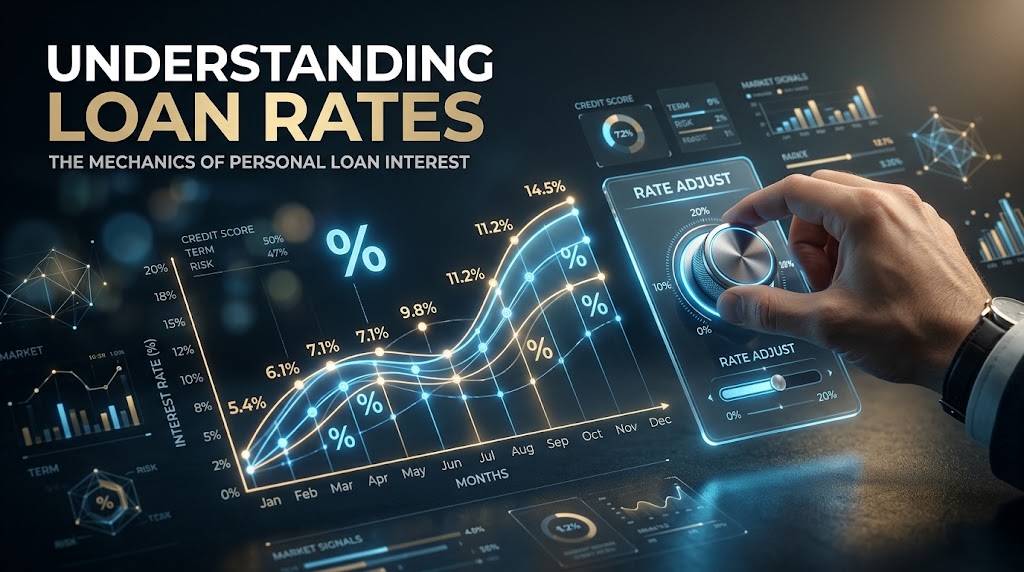
- Credit history and score: a record of on-time payments signals lower risk and earns lower rates.
- Income and debt-to-income ratio: lenders want to see that the new payment fits comfortably into your budget.
- Loan amount and term: longer terms often carry higher rates because the lender's risk lasts longer.
- Market rates: when central banks raise or lower interest rates, lenders' funding costs move and loan rates follow.
- Collateral: most personal loans are unsecured. Secured loans, backed by a car or savings, usually cost less.
Advertised "from" rates are typically available only to applicants with excellent credit. Your actual offer may be considerably higher.
How the term changes your total cost
The same $10,000 loan looks very different depending on the rate and the term:
| Rate | Term | Monthly payment | Total interest |
|---|---|---|---|
| 12% | 36 months | $332.14 | $1,957 |
| 12% | 60 months | $222.44 | $3,347 |
| 18% | 36 months | $361.52 | $3,015 |
Stretching the term from three to five years cuts the monthly payment by about $110 but adds almost $1,400 in interest. Choose the shortest term whose payment you can afford reliably, with room to spare for unexpected expenses.
How loan payments are calculated
Installment loans use the standard annuity formula:
Payment = P × i ÷ (1 − (1 + i)−n)
where P is the loan amount, i the monthly interest rate (annual rate ÷ 12) and n the number of payments. Early payments consist mostly of interest; as the balance shrinks, more of each payment goes toward the principal. That is why extra payments early in the term save the most interest.
Fixed vs. variable rates
Most personal loans have a fixed rate, so your payment never changes. Some lenders offer variable-rate loans that start lower but can rise with market rates. A fixed rate makes budgeting easier and protects you if rates go up.
Fees and fine print to check
- Origination or arrangement fees, often deducted from the amount you receive.
- Prepayment penalties for paying off the loan early. Many lenders charge none; some do.
- Late payment fees and how late payments are reported to credit bureaus.
- Payment protection insurance or other add-ons, which are usually optional and can be expensive.
How to get a lower rate
- Check your credit report for errors before applying and correct them.
- Pre-qualify with several lenders. Many use a soft credit check that does not affect your score.
- Reduce existing debt, especially credit card balances, to improve your debt-to-income ratio.
- Borrow only what you need and choose the shortest affordable term.
- Consider a co-applicant or a secured loan if your credit profile is still developing.
When a personal loan makes sense
A personal loan can be a reasonable way to finance a necessary, one-off expense or to consolidate expensive credit card debt into a lower, fixed rate with a clear end date. It is rarely a good idea for discretionary spending. For buying a home, a mortgage is designed for the job and usually much cheaper.
Before you borrow, make sure the payment fits your budget even if your income drops for a while. More guides on borrowing: loan rates.