Credit Card Payoff Calculator: Payoff Date, Interest and Payment
Enter your balance and APR, then either your monthly payment to see your payoff date, or a target date to see the payment you need. Include new purchases if you keep using the card, compare with minimum payments and download the full payoff schedule.
Listen to this article
Key takeaways
- A $5,000 balance at 22.15% APR paid at $200 a month is gone in 34 months with about $1,768 of interest.
- Paying only a typical minimum (1% of the balance plus interest) stretches the same debt to about 19 years and $8,159 of interest.
- To clear $5,000 at that rate in two years, you need about $260 a month.
- If your payment does not cover the monthly interest, the balance never shrinks. At 22.15%, the first month's interest on $5,000 is about $92.
Credit card debt is expensive because interest is charged on the full balance every month and the minimum payment is designed to keep the balance alive for years. This credit card payoff calculator works two ways: enter a fixed monthly payment to see your payoff date and total interest, or choose a target date to see the payment you need. If you keep using the card, add your expected new purchases per month.
Credit card payoff calculator
Assumes a constant APR with interest charged monthly at APR / 12 on the previous balance, new purchases added each month, then your payment. Card issuers calculate interest on the average daily balance, so real statements differ slightly. The minimum-payment comparison uses a common formula: 1% of the balance plus interest, at least $25.
How credit card interest is charged
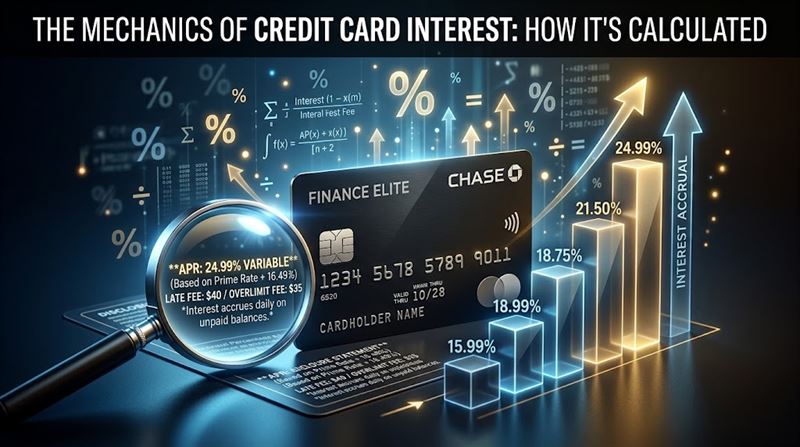
Card issuers convert the APR into a daily periodic rate (the APR divided by 365 at most issuers) and apply it to your average daily balance over the billing cycle. Over a month, that comes very close to the APR divided by 12, which is what this calculator uses. If you pay the full statement balance by the due date, most cards charge no interest at all on purchases thanks to the grace period; once you carry a balance, interest applies from the date of each new purchase as well. The step-by-step math is in how credit card interest is calculated.
For context, the Federal Reserve reports that card accounts that were charged interest paid an average APR of 22.15% in the second quarter of 2026.
Example: $5,000 at 22.15% APR
| Monthly payment | Time to pay off | Total interest |
|---|---|---|
| Minimum (1% + interest, at least $25) | 19 years, 3 months | $8,159 |
| $150 | 4 years, 5 months | $2,834 |
| $200 | 2 years, 10 months | $1,768 |
| $250 | 2 years, 2 months | $1,298 |
| $300 | 1 year, 9 months | $1,031 |
| $500 | 1 year | $579 |
The first minimum payment on this balance is about $142, not far below the $150 plan. The difference is what happens next: the minimum shrinks as the balance falls, so the payoff drags on for almost two decades. A fixed payment stays the same and finishes in a few years. That is the single most important habit for getting out of card debt.
Why minimum payments cost so much
Issuers typically set the minimum at 1% of the balance plus that month's interest and fees, or at 2% to 3% of the balance, with a floor of about $25 to $40. Either way, most of each minimum payment goes to interest in the early years. Your statement must show how long payoff takes at the minimum and what it costs, along with the payment needed to clear the balance in three years. That disclosure is required by the Credit CARD Act. Our guide to what happens if you only pay the minimum explains the formulas and the effect on your credit score.
Payment needed to be debt-free by a target date
A fixed payment that clears the balance in a set time follows the same formula as a loan payment. For $5,000 at 22.15%:
| Debt-free in | Monthly payment |
|---|---|
| 12 months | $468.33 |
| 24 months | $259.76 |
| 36 months | $191.34 |
Choose "The payment to be debt-free by a date" in the calculator to get this figure for any number of months. New purchases slow everything down: with $50 of new charges every month, the same $200 payment takes 53 months instead of 34 and costs about $2,834 in interest instead of $1,768.
Ways to pay less interest
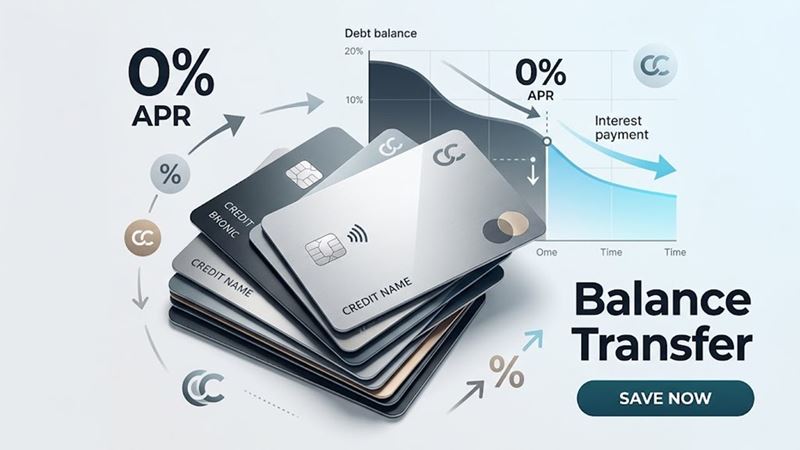
- Balance transfer card. A 0% introductory APR for 12 to 21 months, usually with a 3% to 5% transfer fee, stops interest while you pay down principal. It only works if you can clear most of the balance before the promotion ends; compare offers in best balance transfer cards.
- Debt consolidation loan. A fixed-rate personal loan below your card APR gives you a fixed end date. Weigh it with personal loan vs. credit card and debt consolidation loans.
- Avalanche or snowball. With several cards, pay minimums on all and put every extra dollar on the highest APR (avalanche, cheapest) or the smallest balance (snowball, faster wins).
- Ask for a lower rate. Issuers sometimes lower the APR for customers with a good payment history, and hardship programs exist for people in temporary trouble.
- Nonprofit credit counseling. A debt management plan can lower card rates in exchange for closing the accounts. Look for agencies affiliated with the National Foundation for Credit Counseling.
Paying down cards also helps your credit
Lower balances reduce your credit utilization, one of the largest factors in your credit score. Getting each card under 30% of its limit, and ideally under 10%, can lift a score noticeably within a statement cycle or two; see credit card utilization.
Frequently asked questions
How is credit card interest calculated per month?
Roughly the APR divided by 12, times your balance. At 22% APR on $5,000, that is about $92 a month. Issuers actually use a daily rate on your average daily balance, which gives nearly the same result.
How long does it take to pay off $5,000 on a credit card?
At 22.15% APR, about 34 months at $200 a month, 21 months at $300, or about 19 years at a typical minimum payment, assuming no new charges.
Does paying more than the minimum reduce interest?
Yes. Everything above the month's interest reduces principal, and lower principal means less interest next month. Even $50 more a month makes a large difference over the life of the debt.
Is it better to pay off a credit card in full or keep a small balance?
Pay in full. Carrying a balance does not help your credit score; it only costs interest. Paying the statement balance by the due date avoids interest entirely on most cards.
Why did my balance go up even though I made a payment?
Interest and any fees were higher than your payment, or new purchases were added. If the payment does not exceed the monthly interest, the balance cannot fall.