Personal Loan vs. Credit Card: Which Is Cheaper?
How personal loans and credit cards compare on interest rates, fees, flexibility and credit impact, a worked $8,000 example and a simple guide to choosing the right one for a purchase or for existing debt.
Listen to this article
Key takeaways
- In Q2 2026, commercial banks charged an average of 11.86% on 24-month personal loans versus 22.15% on credit card accounts charged interest (Federal Reserve).
- On $8,000 repaid over three years, a card at 22.15% costs about $3,021 in interest; a 12% loan with a 5% origination fee about $2,069 in interest and fees.
- A personal loan has a fixed payment and end date; a card lets you borrow and repay flexibly but makes it easy to stay in debt.
- For balances you can repay within about a year and a half, a 0% balance transfer card can beat both.
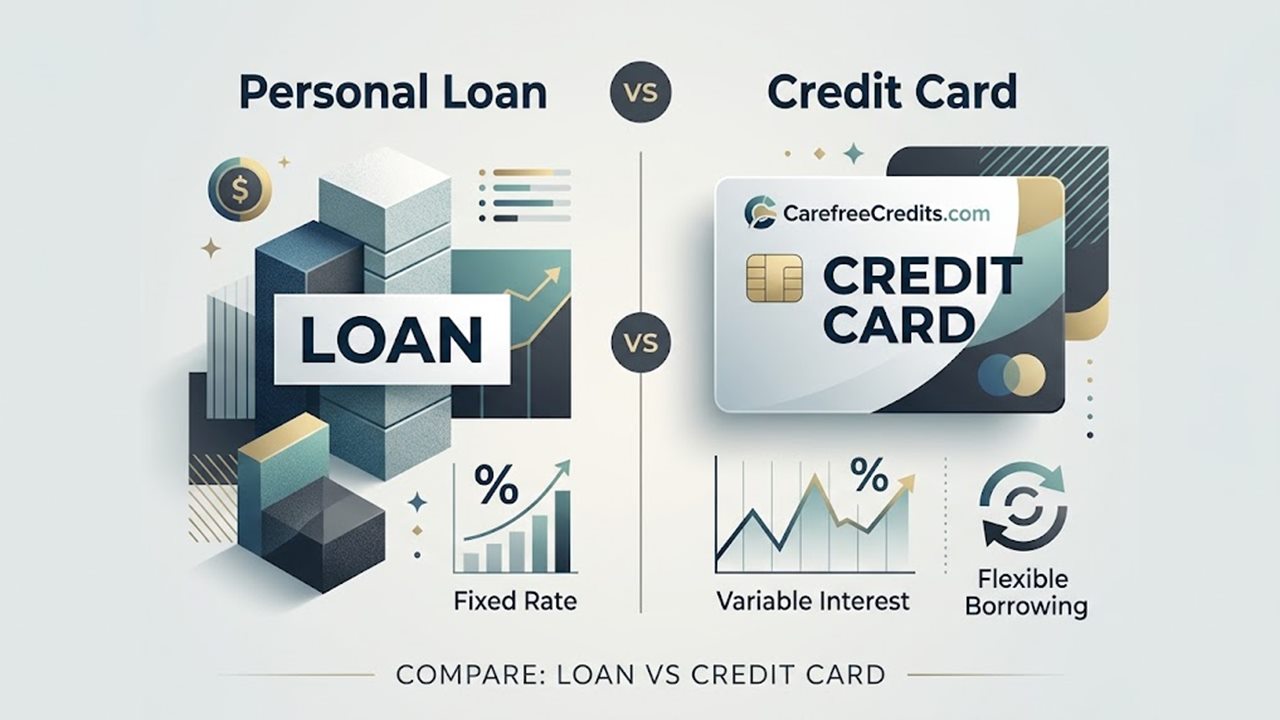
When you need to borrow a few thousand dollars, or want to get out from under card debt, the two most common options are a credit card and a personal loan. They are priced and structured very differently. A personal loan gives you a lump sum at a fixed rate with fixed payments; a credit card is a revolving line you can reuse, usually at a much higher rate. Which one is cheaper depends on how long you need the money and what rate you can get.
Personal loan vs. credit card at a glance
| Personal loan | Credit card | |
|---|---|---|
| How you borrow | Lump sum, once | Revolving line, borrow and repay repeatedly |
| Interest rate | Fixed; 11.86% bank average (24-month, Q2 2026), roughly 6% to 36% depending on credit | Variable; 22.15% average for accounts charged interest (Q2 2026) |
| Fees | Origination fee of 0% to about 10% at some lenders | Annual fee on some cards; balance transfer and cash advance fees |
| Repayment | Fixed monthly payment, fixed end date (often 2 to 7 years) | Minimum payment that shrinks with the balance; no end date |
| Interest-free option | No | Grace period if paid in full; 0% intro APR offers |
| Credit score effect | Installment account; can lower card utilization | High balances raise utilization and can lower your score |
Example: $8,000 repaid over three years
| Option | Monthly payment | Interest and fees |
|---|---|---|
| Credit card at 22.15% APR, paid off in 36 months | $306.14 | $3,021 |
| Personal loan at 12% with a 5% origination fee (borrow $8,421 to net $8,000) | $279.70 | $2,069 |
| Personal loan at 11.86% with no fee | $265.18 | $1,546 |
| 0% balance transfer card, 18 months, 4% transfer fee | $462.22 | $320 |
The loan saves about $950 to $1,475 compared with the card, depending on the fee. The balance transfer is cheapest by far but requires a payment of more than $460 a month to clear the balance before the promotion ends; any amount left over starts accruing the card's regular APR. The card row assumes you actually pay $306 a month. At a typical minimum payment, the same balance would take well over a decade; the credit card interest calculator shows your own numbers.
When a personal loan is the better choice
- Larger amounts you will repay over several years, such as a home repair or consolidating several cards. See debt consolidation loans.
- You want a firm end date and a payment that does not invite you to borrow again.
- Your credit qualifies for a rate well below your card APR. The price depends heavily on your score; see what credit score you need and current average personal loan rates.
- You want to lower credit utilization. Moving card debt to an installment loan often lifts your score, as long as you do not run the cards up again.
When a credit card is the better choice
- You can pay it off within the grace period. Then the card costs nothing and may earn rewards.
- A 0% intro APR offer covers the time you need. New-purchase and balance transfer offers of 12 to 21 months exist for applicants with good credit; compare them in best 0% APR cards and best balance transfer cards.
- Small or irregular amounts that would not justify a loan's minimum size or origination fee.
- Purchase protections such as disputing a charge for goods not received.
Common mistakes
- Comparing the interest rate instead of the APR. A loan's APR includes the origination fee; a 12% rate with a 5% fee is closer to a 15.6% APR on a three-year loan.
- Consolidating and then running the cards up again. This leaves you with the loan and new card debt. Consider lowering limits or putting the cards away.
- Choosing the longest term for the lowest payment. A five-year loan costs much more interest than a three-year loan at the same rate.
- Ignoring the end of a 0% promotion. Mark the date and plan the payoff in advance.
Checkout financing offers a third option for single purchases; see how buy now, pay later plans compare and when they cost interest.
Frequently asked questions
Is it smart to take out a personal loan to pay off credit cards?
Often yes, if the loan's APR is clearly below your card rates and you stop adding new card debt. It turns open-ended debt into a fixed payoff plan.
Does a personal loan hurt your credit more than a credit card?
Applying causes a hard inquiry and a new account, which can lower your score slightly for a few months. Over time, on-time payments and lower card utilization usually help more than the inquiry hurts.
What is a good interest rate on a personal loan?
Anything at or below the Federal Reserve's bank average of 11.86% (Q2 2026) is competitive; applicants with excellent credit may qualify for single-digit rates.
Which is easier to get, a personal loan or a credit card?
Credit cards, especially secured cards, are usually easier for people with limited credit. Personal loans require income verification and an acceptable debt-to-income ratio.
Can I pay off a personal loan early?
Most lenders allow it without a prepayment penalty, but check the loan agreement. Paying early saves interest.