Average Personal Loan Interest Rates in 2026: What Borrowers Actually Pay
The latest Federal Reserve figures, the range lenders actually charge, how much a few percentage points cost on a real loan and why the advertised rate is rarely the one you get.
Listen to this article
Key takeaways
- Commercial banks charged an average of 11.86% on 24-month personal loans in the second quarter of 2026, according to the Federal Reserve.
- Across banks, credit unions and online lenders, quoted APRs run from roughly 6% to 36%. Your credit score, income and debt load decide where you land.
- On a $10,000 three-year loan, the difference between 12% and 25% APR is about $2,360 in interest.
- Compare offers by APR, not the interest rate alone: origination fees can add several percentage points.
- Federal credit unions may not charge more than 18% on most loans.
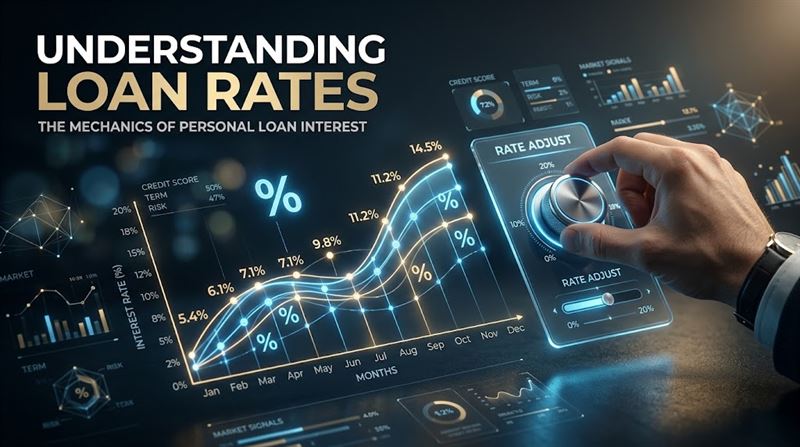
"What is a normal rate for a personal loan?" sounds like a question with one answer. In practice there are two: the average the market reports, and the rate a lender is willing to offer you. They can be more than 20 percentage points apart. This guide uses official data to show both, then puts numbers on what the difference costs.
Please note
Rates as of early October 2026. Personal loan pricing changes with the market and differs by lender, state and applicant. Treat the figures below as a benchmark, not an offer.
The official average: what the Federal Reserve reports
The most reliable public benchmark is the Federal Reserve's G.19 consumer credit release, which tracks the interest rate commercial banks charge on a 24-month personal loan. Its latest figures, published on September 8, 2026, put that rate at 11.86% for the second quarter of 2026.
| Product (commercial banks, Q2 2026) | Average rate |
|---|---|
| Personal loan, 24 months | 11.86% |
| New car loan, 60 months | 7.14% |
| Credit card plans, accounts charged interest | 22.15% |
Two caveats. First, banks lend mostly to borrowers with good credit, so this figure sits at the lower end of what the overall market pays. Online lenders that serve a wider range of credit profiles often quote far higher rates. Second, it is an interest rate, not an APR, so origination fees are not included.
The range lenders actually quote
Most online lenders and banks advertise APR ranges that start somewhere around 6% to 8% for top-tier applicants and run up to about 36%. Many mainstream lenders stop at 35.99%, a ceiling that reflects the 36% rate many consumer advocates and several states treat as the upper limit for small loans. Federal credit unions are bound by an 18% ceiling on most loans, which the NCUA board has extended through September 2027; for small payday alternative loans the limit is 28%.
Where you fall in that range depends on three things above all:
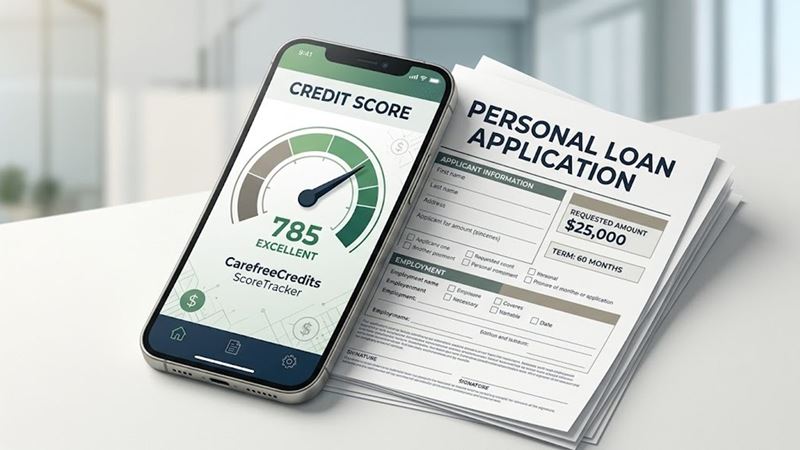
- Credit score and history. The single biggest pricing factor. Late payments, high card balances or a thin file push the rate up quickly. See what credit score you need for a personal loan.
- Debt-to-income ratio. Your monthly debt payments divided by gross monthly income. Many lenders get cautious above about 40% to 50%.
- Loan term and amount. Longer terms usually carry higher rates, and very small loans are often priced higher because fixed costs weigh more.
What different rates cost on a $10,000 loan
The table shows the monthly payment and total interest on $10,000 borrowed for 36 months with a fixed rate and equal payments.
| APR | Monthly payment | Total interest |
|---|---|---|
| 9% | $318 | $1,448 |
| 12% | $332 | $1,957 |
| 15% | $347 | $2,480 |
| 20% | $372 | $3,379 |
| 25% | $398 | $4,314 |
| 35.99% | $458 | $6,487 |
Moving from 25% to 12% saves $2,357 over three years, more than many people spend on a vacation. A longer term lowers the payment but raises the total: the same $10,000 at 12% over 60 months costs $222 a month but $3,347 in interest, about $1,390 more than the 36-month version.
Why the advertised rate and your rate differ
Origination fees
Many online lenders charge an origination fee, often between 1% and 10% of the loan, usually deducted from the money you receive. That raises the APR above the interest rate.
Example
You borrow $10,000 at a 12% interest rate for 36 months, and a 5% origination fee is deducted, so $9,500 reaches your account. You still repay $332.14 a month on the full $10,000. Measured against the $9,500 you actually received, the APR is about 15.6%, not 12%.
This is why lenders must disclose the APR under the Truth in Lending Act, and why it is the number to compare. The mechanics are explained in detail in how personal loan interest rates work.
"Rates from" means the best case
The lowest advertised APR is reserved for borrowers with excellent credit, strong income, low debt and often an autopay discount. Prequalification, which uses a soft credit check and does not affect your score, is the only way to see your own number before you apply.
How the 2026 rate environment affects personal loans
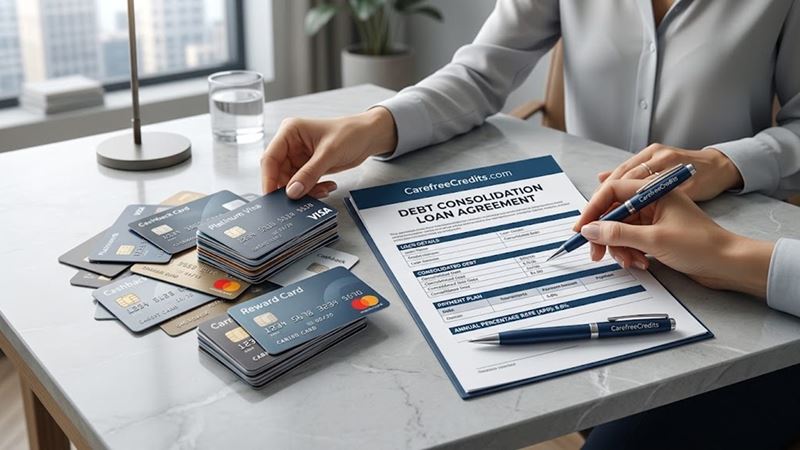
Most personal loans have fixed rates, so an existing loan does not change when the Federal Reserve moves. New loans do respond, with a lag. After the Fed raised its target range to 3.75% to 4.00% on September 16, 2026, lenders' own funding costs rose, which tends to nudge new offers upward. If you are comparing a consolidation loan with credit card debt, note that card APRs, which are usually tied to the prime rate, react faster: the prime rate rose to 7.00% on September 17, 2026.
How to get a rate at the low end
- Check your credit reports at AnnualCreditReport.com and dispute errors before applying.
- Lower your card balances if you can; utilization above about 30% weighs on most scores.
- Prequalify with several lenders, including your bank and a local credit union, within a short period.
- Compare APR and total cost, not just the monthly payment.
- Choose the shortest term you can comfortably afford.
- Consider a creditworthy co-borrower if your own profile is thin, knowing they share full responsibility.
Frequently asked questions
What is a good interest rate on a personal loan?
Anything at or below the Federal Reserve's bank average of 11.86% (Q2 2026) is a strong offer. Applicants with excellent credit can find single-digit APRs; fair credit typically means rates in the high teens or twenties.
What is the average personal loan rate for bad credit?
There is no official average by credit score, but offers for applicants with poor credit commonly sit near the top of lenders' ranges, often 25% to 36%. Credit unions, which are capped at 18% for most loans, are worth checking first.
Are personal loan rates fixed?
Most are fixed for the life of the loan, so the payment never changes. Some banks and lines of credit offer variable rates tied to an index such as the prime rate.
Does checking my rate hurt my credit score?
Prequalification uses a soft inquiry and does not affect your score. A formal application usually triggers a hard inquiry, which typically lowers a FICO score by less than five points.
Why is my APR higher than the interest rate?
Because the APR includes the origination fee and certain other charges, expressed as a yearly rate. If there are no fees, APR and interest rate are the same.