Debt Consolidation Loans: How They Work and When They Really Save Money
The math behind consolidating credit card debt into one personal loan, a worked example with 2026 rates, the alternatives worth comparing and the trap that undoes most of the savings.

Listen to this article
Key takeaways
- A debt consolidation loan is a personal loan used to pay off several debts, leaving one fixed payment and a fixed end date.
- It saves money only if the loan's APR, including fees, is clearly below the rates on the debts it replaces. Credit card accounts charged interest averaged 22.15% in Q2 2026.
- In our example, consolidating $15,000 of card debt saves about $3,200 in interest and finishes the debt nine months sooner.
- The biggest risk is behavioral: running the cards up again after they are paid off.
Credit card debt is expensive for a simple reason: the interest rate is high and the minimum payment is low, so balances shrink slowly. Consolidation attacks both problems at once by swapping revolving debt for an installment loan with a lower rate and a schedule that ends. Whether it works depends on numbers you can check before you sign.
Please note
General information as of October 2026, not individual financial advice. If your debts feel unmanageable, a nonprofit credit counselor can review your situation for free or at low cost.
How a debt consolidation loan works
- You apply for a personal loan large enough to cover the balances you want to combine.
- The lender either pays your creditors directly or deposits the money so you can pay them yourself.
- You repay the new loan in equal monthly installments, usually over two to five years.
Nothing about your total debt changes on day one. What changes is the price of carrying it and the structure of repayment. A fixed installment also tends to help credit scores over time, because it lowers the share of your card limits you are using, one of the most heavily weighted scoring factors.
The math: a worked example
Suppose you owe $15,000 across several credit cards at an average APR of 22.15%, the Federal Reserve's Q2 2026 figure for card accounts that are charged interest, and you pay $500 a month.
| Keep the cards | Consolidation loan | |
|---|---|---|
| Rate | 22.15% APR | 12% interest + 5% fee |
| Amount borrowed | – | $15,789 (nets $15,000) |
| Monthly payment | $500 | $524 |
| Time to debt-free | 45 months | 36 months |
| Total interest and fees | $7,058 | $3,880 |
The loan saves about $3,180 and nine months, even after a 5% origination fee. Two things make this work: a rate roughly ten points lower, and a payment that is only $24 higher. If you instead put the same $524 a month toward the cards, you would still pay about $6,524 in interest over 42 months, so the rate cut, not the payment, does most of the work.
Run the same comparison with your own numbers. A consolidation loan at 25% with a 6% fee would barely beat cards at 22%; at that point it buys structure, not savings.
When consolidation makes sense
- Your credit qualifies you for an APR well below your current average rate.
- You can afford the fixed payment without new borrowing.
- You have a plan to keep the paid-off cards at a zero or near-zero balance.
- The debts are high-rate and unsecured: cards, store cards, high-interest personal loans.
When it does not
- The new APR is not much lower. Fees can erase a small rate advantage.
- You would stretch the term to cut the payment. A seven-year loan at a lower rate can cost more in total than aggressive card payoff.
- The debt is already cheap, such as a 0% promotional balance or a low-rate auto loan.
- The underlying problem is spending, not interest. Then consolidation often leads to two sets of debt.
Alternatives worth comparing
| Option | Typical cost | Best for |
|---|---|---|
| Consolidation loan | Fixed APR, often with an origination fee | Larger balances, need for a fixed end date |
| Balance transfer card | 0% intro APR for 12 to 21 months plus a 3% to 5% transfer fee | Balances you can repay within the promotion |
| Debt management plan | Reduced card rates negotiated by a nonprofit agency, small monthly fee | Borrowers who do not qualify for a good loan rate |
| Home equity loan or HELOC | Lower rate, but your home secures the debt | Rarely the right tool for card debt |
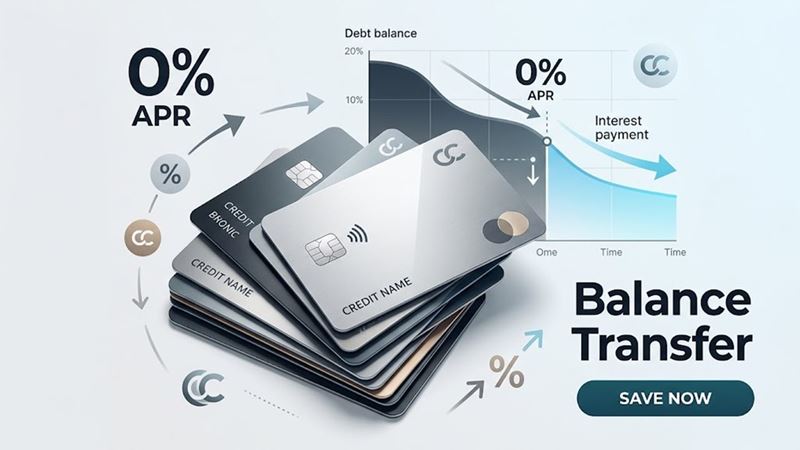
A balance transfer can be cheaper than any loan if the numbers fit: moving $15,000 with a 4% fee costs $600 up front, and paying it off within an 18-month promotion takes about $867 a month. Our guides to balance transfer cards and how card interest is calculated help with that comparison. Turning unsecured debt into debt secured by your house is a serious step; see HELOC vs. home equity loan before considering it.
How to apply the smart way
- List every debt with balance, APR and minimum payment, and calculate your weighted average rate.
- Prequalify with several lenders using soft credit checks, including your bank and a credit union.
- Compare APR, fee and total repayment, not just the monthly figure.
- Ask for direct payment to creditors if the lender offers it, so the money cannot be redirected.
- Keep the old accounts open but unused unless they charge an annual fee; closing them can raise your utilization ratio.
What happens to your credit score
Expect a small, temporary dip from the hard inquiry and the new account. Over the following months, lower card utilization and on-time installment payments usually outweigh it. The damage comes from late payments on the new loan or from rebuilding card balances.
Frequently asked questions
Is a debt consolidation loan a good idea?
It is a good idea when it lowers your total cost and you can stop adding new debt. It is a bad idea if the APR is similar to what you pay now or if the paid-off cards are likely to fill up again.
What credit score do I need for a debt consolidation loan?
Requirements vary by lender. The rate, not just approval, is what matters: a score in the good-to-excellent range (roughly 670 and above on the FICO scale) usually makes the savings meaningful.
Does consolidation reduce the amount I owe?
No. It changes the rate and the structure. Debt settlement, which tries to reduce the balance, is a different and much riskier process with tax and credit consequences.
Can I consolidate student loans with a personal loan?
You can, but federal student loans would lose protections such as income-driven repayment and forgiveness programs. Federal loans have their own consolidation program through the Department of Education.
Should I close my credit cards after consolidating?
Usually not. Keeping them open with zero balances helps your utilization ratio and length of credit history. Close a card only if it has an annual fee or you cannot trust yourself not to use it.