The 50/30/20 Budget Rule: How It Works With Real Numbers
How to split take-home pay into needs, wants and savings, what counts in each bucket, a worked example, how to adapt the rule when rent is high and where to keep the 20% so it earns interest.
Listen to this article
Key takeaways
- The rule splits after-tax income: 50% needs, 30% wants, 20% savings and extra debt repayment.
- On $5,000 a month of take-home pay: $2,500 needs, $1,500 wants, $1,000 savings.
- Minimum debt payments are needs; anything above the minimum counts toward the 20%.
- If housing alone takes a third of your spending, as it does for the average U.S. household, adjust the split rather than abandoning the plan.
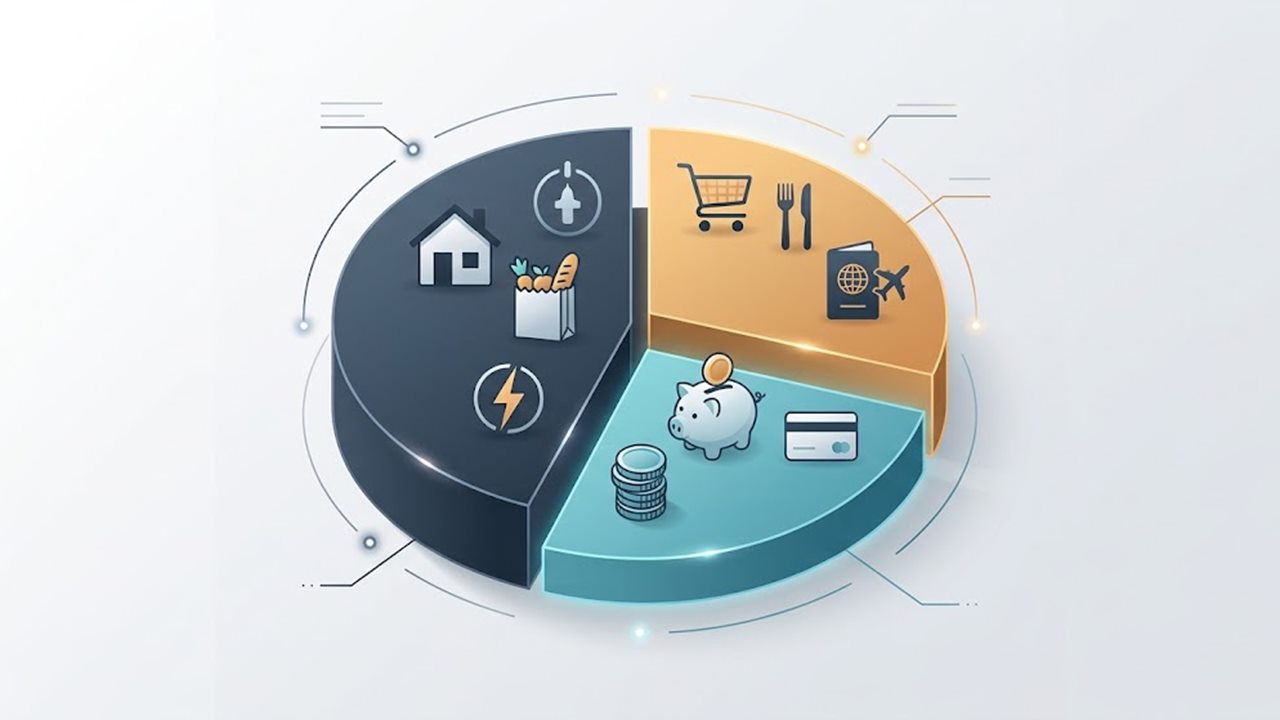
The 50/30/20 rule is one of the simplest budgets there is. Instead of tracking dozens of categories, you sort every expense into three buckets and check that each stays within its share of your income. It was popularized by Elizabeth Warren and Amelia Warren Tyagi in their 2005 book "All Your Worth," and it works well as a starting point because it guarantees one thing: a fixed share of every paycheck goes to your future.
The three buckets
| Bucket | Share | Includes |
|---|---|---|
| Needs | 50% | Rent or mortgage, utilities, groceries, insurance, transportation to work, child care, minimum debt payments |
| Wants | 30% | Dining out, travel, streaming, hobbies, shopping beyond basics, upgrades such as a nicer car or apartment |
| Savings and debt | 20% | Emergency fund, retirement contributions, investing, extra payments on credit cards and loans |
The base is take-home pay: what reaches your bank account after taxes. If your employer deducts 401(k) or HSA contributions before your paycheck arrives, add them back and count them in the 20%.
Worked example
| Take-home pay: $5,000 a month | Budget | Actual |
|---|---|---|
| Needs (50%) | $2,500 | $2,750 |
| Wants (30%) | $1,500 | $1,250 |
| Savings and extra debt payments (20%) | $1,000 | $1,000 |
Here needs run $250 over, so wants are trimmed by $250 to protect savings. That is the rule's main lesson: when one bucket grows, wants give way, not savings. Your exact take-home pay after federal tax, Social Security and Medicare can be estimated with the paycheck tax calculator.
How to set it up
- Find your monthly take-home pay. For irregular income, use the average of the last six to twelve months, or your lowest typical month.
- List fixed needs from bank and card statements.
- Automate the 20% on payday: a transfer to a high-yield savings account and your retirement contributions.
- Give wants their own account or card, so you can see when the 30% is used up.
- Review once a month and adjust.
What goes in the 20%
A practical order: first a starter emergency fund of about one month of expenses, then enough in your 401(k) to get any employer match, then high-interest debt, then a full emergency fund of three to six months, then more retirement saving and investing. Sizing the cushion is explained in how much to keep in an emergency fund. Paying off a card at 22% APR is a guaranteed return few investments match; see how to pay off credit card debt.
Keep the cash part where it earns interest. Online high-yield savings accounts pay around 4% APY in fall 2026, while the FDIC's national average for savings is 0.37%. On $10,000 that is about $400 a year versus $37; see high-yield savings accounts.
When 50/30/20 does not fit
Housing is the largest expense for most households. In the Bureau of Labor Statistics' Consumer Expenditure Survey for 2024, housing averaged $26,266 a year, 33.4% of total household spending. In expensive cities, rent alone can exceed half of take-home pay. Common adjustments:
- 60/20/20: more for needs, fewer wants, savings protected.
- 70/20/10: a temporary version while you raise income or move to cheaper housing.
- 50/20/30 for big savers: 30% to savings and 20% to wants, common among people aiming at early retirement or a home down payment.
The percentages are guidelines. A plan you follow at 15% savings beats a perfect plan you abandon after a month.
Why it matters
The Federal Reserve's 2025 survey of household economics found that 63% of adults would cover a $400 emergency expense with cash or its equivalent, unchanged from 2024. Roughly a third could not. A simple rule that sets savings aside first is one of the most reliable ways to land in the first group. How your savings compare with others your age is covered in how much savings you should have by age.
Frequently asked questions
Is the 50/30/20 rule based on gross or net income?
On net, after-tax income. Add back any savings deducted from your paycheck, such as 401(k) contributions, and count them toward the 20%.
Are debt payments needs or savings?
Minimum required payments are needs. Extra payments to pay debt off faster belong in the 20%.
Is groceries a need or a want?
Basic groceries are a need. Restaurant meals, takeout and premium items you could do without are wants.
What if I cannot save 20%?
Start with any amount you can automate, even 5%, and raise it with every raise or when a debt is paid off.
Does 50/30/20 work with irregular income?
Yes. Budget from a conservative monthly average, and keep extra cash in savings to smooth out low months.