Auto Loan Interest Rates by Credit Score (2026): New and Used Car Averages
Current average car loan rates for every credit tier, what they mean for your monthly payment, why used cars cost more to finance and how to lower your rate before you visit the dealer.
Listen to this article
Key takeaways
- Average APR in Q2 2026 (Experian): 6.35% for new cars and 11.19% for used cars.
- Credit matters enormously: 4.41% for super-prime new-car borrowers vs. 16.11% for deep subprime.
- On a $40,000, 60-month loan, that gap is about $13,900 in interest.
- Longer terms lower the payment but raise the total cost; a 72-month loan at 6.15% costs about $1,370 more than 60 months.
- Get preapproved with a bank or credit union before you shop, so the dealer has a rate to beat.
Car buyers tend to negotiate the price and then accept whatever financing they are offered. That is backwards: on a typical loan, the interest rate can move the total cost by more than a hard-won discount. The numbers below show how much your credit score decides, using Experian's latest market data.
Please note
Averages from Experian's State of the Automotive Finance Market for Q2 2026 and the Federal Reserve's G.19 release of September 8, 2026. Your rate depends on the lender, vehicle, term, down payment and state.
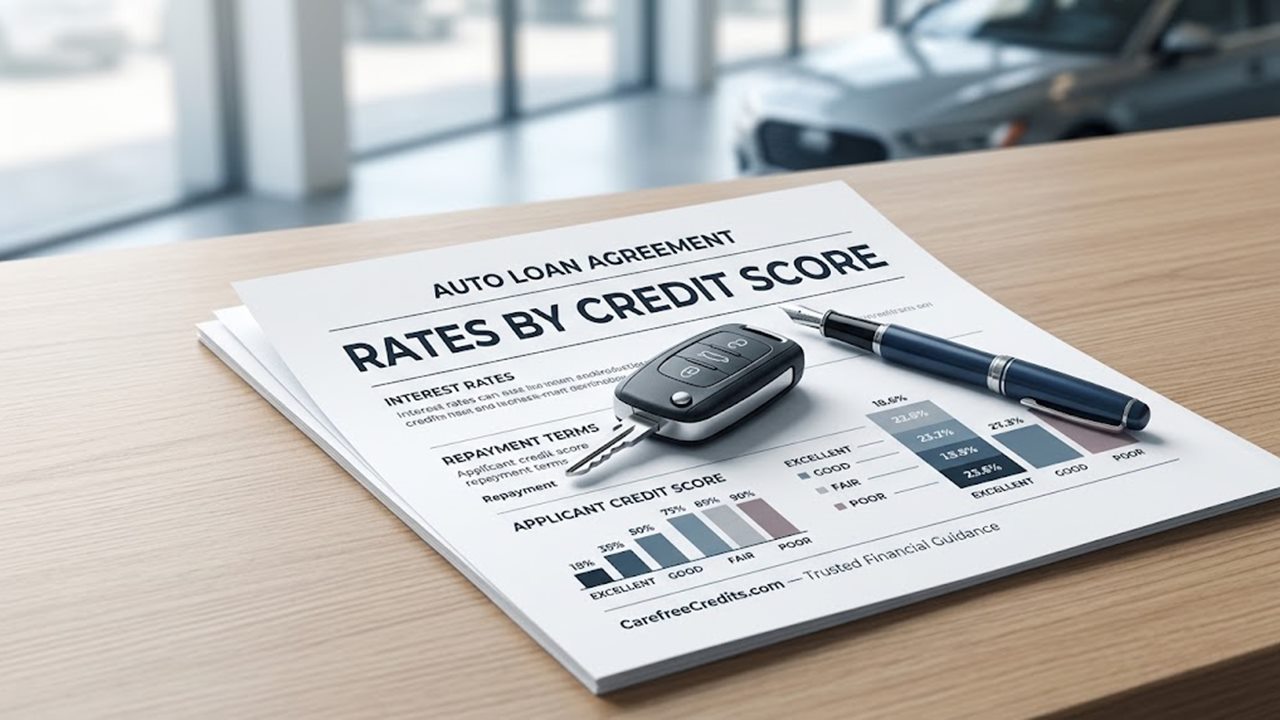
Average auto loan rates by credit score
| Credit tier (VantageScore 4.0) | New car APR | Used car APR |
|---|---|---|
| Super prime (781–850) | 4.41% | 6.29% |
| Prime (661–780) | 6.15% | 8.81% |
| Near prime (601–660) | 9.71% | 13.93% |
| Subprime (501–600) | 13.52% | 19.10% |
| Deep subprime (300–500) | 16.11% | 21.62% |
| All borrowers | 6.35% | 11.19% |
Experian groups borrowers by VantageScore 4.0. Many auto lenders use FICO Auto Scores instead, which run from 250 to 900, so your own tier may differ slightly from these bands. The Federal Reserve reports a similar level for banks: 7.14% on 60-month new car loans in Q2 2026, while auto finance companies averaged 6.3% in June 2026, helped by manufacturer-subsidized promotions.
What these rates mean in dollars
New car: $40,000 financed for 60 months
| APR | Monthly payment | Total interest |
|---|---|---|
| 4.41% (super prime) | $744 | $4,645 |
| 6.15% (prime) | $776 | $6,566 |
| 9.71% (near prime) | $844 | $10,651 |
| 13.52% (subprime) | $921 | $15,248 |
| 16.11% (deep subprime) | $975 | $18,504 |
Used car: $25,000 financed for 60 months
| APR | Monthly payment | Total interest |
|---|---|---|
| 6.29% (super prime) | $487 | $4,202 |
| 8.81% (prime) | $517 | $5,999 |
| 13.93% (near prime) | $581 | $9,848 |
| 19.10% (subprime) | $650 | $13,993 |
| 21.62% (deep subprime) | $685 | $16,105 |
Why used cars cost more to finance
Lenders price used-car loans higher because the collateral is worth less, depreciates less predictably and is harder to value. Used-car buyers are also, on average, more likely to have weaker credit, which pulls the average up. A certified pre-owned vehicle financed through the manufacturer's lender is the main exception: these sometimes carry promotional rates closer to new-car levels.
The loan term trap
Terms of 72 and even 84 months have become common because they keep payments down while prices stay high. The Federal Reserve's data shows finance-company new-car loans averaging 67 months and $41,705 financed in June 2026. Longer terms cost more in two ways:
- More interest. $40,000 at 6.15% costs $6,566 in interest over 60 months but $7,934 over 72 months.
- Negative equity. Cars lose value fastest in the first years. With a long term and a small down payment, you can owe more than the car is worth, which becomes a problem if it is totaled or you want to trade it in.
A practical guideline used by many planners: put at least 10% to 20% down, keep the term at 60 months or less, and keep total car costs within a comfortable share of take-home pay.
Dealer financing vs. bank or credit union
Dealers arrange financing through partner lenders and may add a markup to the rate the lender approves, which they keep as compensation. That is legal, but it is negotiable. Walking in with a preapproval from your bank, a credit union or an online lender gives you a benchmark: if the dealer can beat it, take the better offer. Manufacturer promotions such as 0% or 1.9% APR can be genuinely cheaper, but they are often offered instead of a cash rebate, so compare both options.
Precomputed interest: check the contract
Most auto loans use simple interest, where paying early saves interest. Some loans, mainly in subprime and buy-here-pay-here lending, use precomputed interest and may calculate early-payoff refunds with the Rule of 78, which front-loads interest. Read how this works in the Rule of 78 explained before signing.
A new tax break for some car buyers (2025–2028)
The 2025 tax law lets borrowers deduct up to $10,000 a year of interest on loans for new vehicles bought for personal use after December 31, 2024, if the vehicle's final assembly took place in the United States and the loan is secured by the vehicle. The deduction phases out above $100,000 of modified AGI ($200,000 for joint filers) and is claimed on Schedule 1-A, without itemizing. Used and leased vehicles do not qualify. More in which loan interest is tax deductible.
How to get a lower auto loan rate
- Check your credit a month or two before shopping and pay card balances down.
- Get two or three preapprovals within a 14-day window. FICO treats multiple auto loan inquiries in a short period as one for scoring purposes.
- Choose a shorter term and a larger down payment.
- Negotiate price and financing separately, and ask the dealer to show the buy rate.
- Refinance later if your credit improves or rates fall; there is usually no penalty on simple-interest loans.
Already paying a high rate? If your score has improved since you bought the car, refinancing your car loan can lower the payment and the total interest.
Frequently asked questions
What is a good interest rate for a car loan in 2026?
For a new car, anything below the 6.35% market average is good, and super-prime borrowers average 4.41%. For a used car, below 11.19% beats the average.
What credit score do I need for a car loan?
There is no universal minimum; lenders finance borrowers across all tiers, but the price rises steeply below prime. Scores above roughly 661 on VantageScore, or the equivalent FICO range, qualify for prime pricing.
Is a 72-month car loan a bad idea?
Not always, but it raises total interest and the risk of owing more than the car is worth. It makes most sense with a low promotional rate and a meaningful down payment.
Can I refinance an auto loan?
Yes. If your credit has improved or market rates have dropped, refinancing can lower the rate. Check for fees and make sure the new term does not stretch the loan unnecessarily.
Is car loan interest tax deductible?
For tax years 2025 to 2028, interest on loans for new, U.S.-assembled personal vehicles can be deducted up to $10,000 a year, subject to income limits. Business use of a car is handled separately on Schedule C.