First-Time Home Buyer Guide 2026: Loans, Down Payments and Programs
Who counts as a first-time buyer, the loan programs with 0% to 3.5% down, how down payment assistance works, what to save beyond the down payment and the steps from preapproval to closing.

Listen to this article
Key takeaways
- Under HUD's definition you are a first-time homebuyer if you have not owned a home in the past three years; certain single parents and displaced homemakers also qualify.
- You rarely need 20% down: 3% (conventional), 3.5% (FHA) or 0% (VA, USDA) is possible.
- State and local down payment assistance can cover part of the down payment or closing costs.
- Budget for closing costs, reserves and moving, not just the down payment.
Buying a first home combines a large financial decision with a process most people have never seen from the inside. The good news is that the U.S. mortgage system has several programs designed for exactly this situation. The challenge is choosing the right one, because the cheapest down payment is not always the cheapest loan.
Please note
General information as of October 2026. Program rules, income limits and assistance funds differ by lender, state and county. Rates move daily; Freddie Mac's 30-year average was 7.28% on October 1, 2026.
Who counts as a first-time home buyer
HUD defines a first-time homebuyer as an individual and spouse who have not owned a home during the three-year period before the purchase. The definition also includes a single parent who owned a home only with a former spouse while married, and a displaced homemaker who owned a home only with a spouse. Many state programs and Fannie Mae and Freddie Mac use the three-year rule as well, so a former owner who has rented for three years usually qualifies again.
Loan programs compared
| Program | Minimum down | Mortgage insurance | Good to know |
|---|---|---|---|
| Conventional 97% (Fannie Mae / Freddie Mac) | 3% | PMI, cancelable at 20% equity | Standard 97% loans need at least one first-time buyer |
| HomeReady / Home Possible | 3% | PMI, cancelable | Income generally up to 80% of area median; homebuyer education may be required |
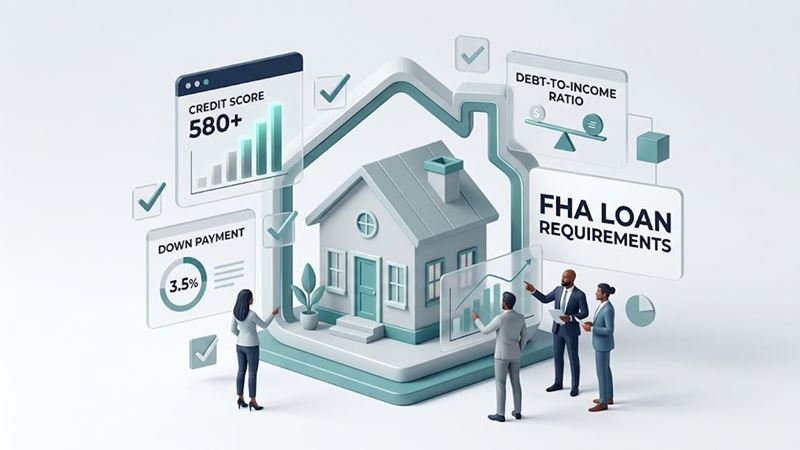
| FHA | 3.5% with a 580+ score; 10% with 500–579 | 1.75% upfront plus annual premium | Flexible credit; 2026 limits from $541,287 |
| VA | 0% | None; one-time funding fee | For eligible veterans, service members and some surviving spouses |
| USDA | 0% | 1% upfront and 0.35% annual guarantee fee | Eligible rural and suburban areas, income limits |
FHA often suits buyers with fair credit, while conventional 3% down can be cheaper for strong credit because PMI can be removed later. Our FHA loan requirements guide compares the costs in detail.
How much cash you really need
On a $350,000 home, the down payment alone ranges widely:
| Down payment | Amount |
|---|---|
| 3% | $10,500 |
| 3.5% | $12,250 |
| 10% | $35,000 |
| 20% | $70,000 |
On top of that, plan for closing costs, often 2% to 5% of the price (lender fees, title insurance, appraisal, prepaid taxes and insurance), reserves that some lenders require, and moving and immediate repairs. Sellers may contribute toward closing costs within program limits, which is negotiable.
Down payment assistance
State housing finance agencies and many cities offer help for first-time and moderate-income buyers. Common forms are:
- Grants that do not have to be repaid.
- Forgivable second loans that disappear if you stay in the home for a set number of years.
- Deferred or low-interest second loans repaid when you sell or refinance.
- Mortgage credit certificates in some states, which turn part of your mortgage interest into a tax credit.
Start with your state housing finance agency's website and ask lenders which programs they work with. Assistance often comes with income limits, price limits and a homebuyer education course.
Using retirement savings
First-time homebuyers may withdraw up to $10,000 (lifetime) from an IRA without the 10% early-withdrawal penalty; income tax still applies to traditional IRA money. Roth IRA contributions can be withdrawn at any time. A 401(k) loan is another option, but it must be repaid and can come due quickly if you leave your job. Weigh this against the long-term cost to your retirement, explained in how to invest for retirement.
The buying process, step by step
- Check your credit and budget, using how much house can I afford.
- Get preapproved with two or three lenders. Mortgage inquiries within a short shopping window count as one for FICO scoring.
- Choose an agent and make offers with financing and inspection contingencies.
- Lock your rate once under contract.
- Inspection and appraisal, then underwriting.
- Review the Closing Disclosure, which you must receive at least three business days before closing.
- Close and keep records of your settlement statement for taxes.
Mistakes first-time buyers commonly make
- Shopping by house price before knowing the full monthly payment.
- Using all savings for the down payment and leaving no emergency fund.
- Opening new credit or changing jobs between preapproval and closing.
- Skipping the inspection to win a bidding war.
- Comparing only rates and ignoring lender fees and points.
When comparing loan offers, decide whether mortgage points are worth buying and whether an adjustable or fixed rate fits how long you plan to stay.
Frequently asked questions
Do I qualify as a first-time buyer if I owned a home before?
Under HUD's definition, yes, if you have not owned a home in the past three years. Specific programs may add their own rules.
What credit score do I need to buy a first home?
About 580 for an FHA loan with 3.5% down, and typically 620 for conventional loans; HomeReady requires 620 and Home Possible 660. Higher scores lower the rate and mortgage insurance cost.
Is there a federal first-time home buyer tax credit in 2026?
No. There is currently no federal first-time buyer tax credit. Some states offer credits or mortgage credit certificates.
Can I buy a house with no money down?
Yes, with a VA or USDA loan if you qualify, or with assistance programs that cover the down payment. Closing costs still need to be paid or negotiated.
How long does it take to close?
Often 30 to 45 days from accepted offer to closing, depending on the lender, appraisal and title work.