Mortgage Calculator: Calculate Your Monthly Payment
Enter the price, down payment, rate and term to see your full monthly payment, including property tax, homeowners insurance, PMI and HOA dues, plus total interest and a year-by-year amortization schedule.

Listen to this article
Key takeaways
- A mortgage payment usually has four parts: principal, interest, property taxes and homeowners insurance (PITI), plus PMI with less than 20% down and HOA dues where they apply.
- On a $320,000 loan at 7.28% for 30 years, principal and interest come to $2,189.48 a month and total interest to about $468,000 over the full term.
- On that loan, each percentage point of rate changes the payment by roughly $205 to $225 a month.
- On a conventional loan, PMI ends automatically once the balance is scheduled to reach 78% of the original value; you can ask to cancel it at 80%.
A mortgage calculator answers the first question every buyer has: what will this home cost me each month? The figure lenders quote first, principal and interest, is only part of it. Property taxes, homeowners insurance, private mortgage insurance and association dues are usually collected with the same payment, and together they can add several hundred dollars a month. The calculator below includes all of them, so the result is close to what you would see on a Loan Estimate.
Mortgage payment calculator
Estimates for a fixed-rate loan. Taxes, insurance and PMI are entered by you and can change over time. PMI is assumed to end automatically when the balance reaches 78% of the original price.
What each input means
Home price. The amount you expect to pay for the property. Use the realistic purchase price rather than the list price if homes in your area sell above or below asking.
Down payment. The cash you put toward the price at closing. The loan amount is the price minus the down payment. Conventional loans allow as little as 3% down and FHA loans 3.5%, but anything below 20% on a conventional loan adds private mortgage insurance. The percentage under the field shows how your down payment compares with the price.
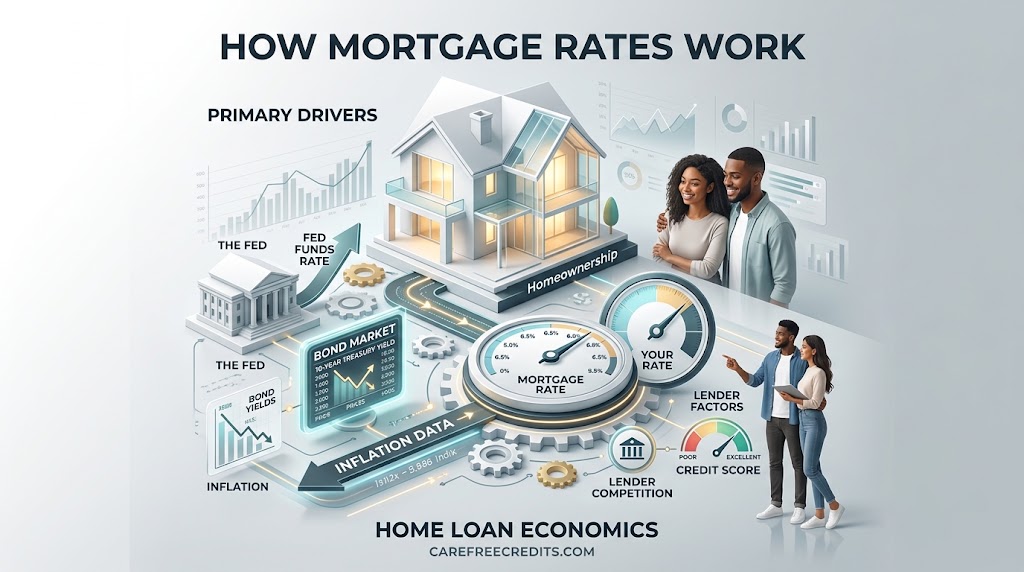
Interest rate. The note rate on the loan, not the APR. The APR includes points and some fees and is useful for comparing offers, but the payment is calculated from the note rate. Freddie Mac's weekly survey put the average 30-year fixed rate at 7.28% on October 1, 2026; your quote depends on your credit score, down payment, loan type and points. How mortgage rates work explains what drives the number.
Loan term. The number of years to repay. A shorter term means a higher payment but far less interest.
Property tax. Your annual property tax bill. Rates are set locally and vary more than any other input: the same house can carry a tax bill twice as high one county over. The listing, the county assessor's website or a local agent can give you the current figure.
Homeowners insurance. The annual premium for a standard homeowners policy. Lenders require it, and premiums have risen sharply in some states, so get a quote before you commit to a price.
PMI rate. The annual cost of private mortgage insurance as a percentage of the loan. It applies only to conventional loans with less than 20% down. Freddie Mac estimates PMI at about $30 to $70 a month for every $100,000 borrowed, roughly 0.36% to 0.84% a year; borrowers with lower credit scores or smaller down payments pay more.
HOA dues. Monthly fees for a homeowners or condominium association. They are not part of the mortgage, but lenders count them when deciding how much you can borrow.
How the monthly payment is calculated
For a fixed-rate loan, the principal and interest payment stays the same for the whole term. It comes from the standard amortization formula:
M = P × r ÷ (1 − (1 + r)−n)
where P is the loan amount, r the monthly interest rate (the annual rate divided by 12) and n the number of monthly payments. Taxes, insurance, PMI and HOA dues are then added: the annual tax and insurance amounts divided by 12, PMI as the annual rate times the loan amount divided by 12, and HOA dues as they are.
Each month, interest is charged on the remaining balance and the rest of the payment reduces principal. That is why the split changes over time even though the payment does not.
Example: a $400,000 home with 20% down
Take a $400,000 home bought with $80,000 down, so the loan is $320,000. The rate is 7.28% for 30 years, property tax is $4,000 a year and insurance $1,800 a year. With 20% down there is no PMI.
| Part of the payment | Per month |
|---|---|
| Principal and interest | $2,189.48 |
| Property tax ($4,000 ÷ 12) | $333.33 |
| Homeowners insurance ($1,800 ÷ 12) | $150.00 |
| Total monthly payment | $2,672.81 |
Over 30 years, the 360 principal and interest payments add up to about $788,200: the $320,000 borrowed plus about $468,200 in interest. In the very first payment, $1,941.33 is interest and only $248.15 goes to principal. The balance does not fall below half of the original loan until about year 22, which is why extra payments early in the loan save so much; the mortgage payoff calculator shows how much.
How the interest rate changes your payment
The rate has the largest effect on what a home costs you over time. The table shows principal and interest on the same $320,000, 30-year loan.
| Interest rate | Monthly principal and interest | Total interest over 30 years |
|---|---|---|
| 5.50% | $1,816.92 | $334,093 |
| 6.00% | $1,918.56 | $370,682 |
| 6.50% | $2,022.62 | $408,142 |
| 7.00% | $2,128.97 | $446,428 |
| 7.28% | $2,189.48 | $468,213 |
| 7.50% | $2,237.49 | $485,495 |
| 8.00% | $2,348.05 | $525,297 |
| 8.50% | $2,460.52 | $565,788 |
A one-point difference, say 7% instead of 8%, changes the payment by about $219 a month and total interest by about $79,000. That is why comparing at least three Loan Estimates on the same day is one of the most valuable things a buyer can do. Points can lower the rate further: each point costs 1% of the loan up front, so they pay off only if you keep the loan long enough.
How your down payment changes the payment
A larger down payment lowers the loan amount, and at 20% it removes PMI. Using the same $400,000 home, 7.28% rate, $4,000 tax and $1,800 insurance, with PMI at 0.6% a year below 20% down:
| Down payment | Loan amount | Principal and interest | PMI | Total monthly payment |
|---|---|---|---|---|
| 3% ($12,000) | $388,000 | $2,654.74 | $194.00 | $3,332.08 |
| 5% ($20,000) | $380,000 | $2,600.01 | $190.00 | $3,273.34 |
| 10% ($40,000) | $360,000 | $2,463.16 | $180.00 | $3,126.50 |
| 15% ($60,000) | $340,000 | $2,326.32 | $170.00 | $2,979.66 |
| 20% ($80,000) | $320,000 | $2,189.48 | $0 | $2,672.81 |
Going from 3% to 20% down cuts the payment by about $660 a month. That does not mean you should empty your savings to reach 20%. A buyer with 5% down keeps cash for closing costs, moving and repairs, and PMI ends on its own as the loan is paid down. At 5% down in this example, PMI would run for about 12 years and cost roughly $27,500 in total; at 15% down, it would end after about 7 years.
PMI explained
Private mortgage insurance protects the lender, not you, if a borrower with a small down payment defaults. It is required on most conventional loans with less than 20% down. The Homeowners Protection Act sets the rules for removing it on loans for a primary residence:
- At 80%: you can request cancellation once the balance reaches 80% of the home's original value, if you are current on payments and meet the lender's conditions, which can include proof that the home has not lost value.
- At 78%: the servicer must end PMI automatically when the balance is scheduled to reach 78% of the original value, as long as you are current.
- At the midpoint: PMI ends no later than halfway through the loan term, even if the balance is higher.
"Original value" means the lower of the purchase price or the appraised value at closing. The calculator applies the 78% rule. FHA loans work differently: they charge an upfront premium and an annual mortgage insurance premium that lasts 11 years or the life of the loan, depending on the down payment. See FHA loan requirements for the 2026 figures.
15-year vs. 30-year mortgage
Lenders price 15-year loans lower than 30-year loans. Freddie Mac's average on October 1, 2026 was 6.60% for 15 years, compared with 7.28% for 30 years.
| $320,000 loan | Rate | Monthly principal and interest | Total interest |
|---|---|---|---|
| 30-year fixed | 7.28% | $2,189.48 | $468,213 |
| 15-year fixed | 6.60% | $2,805.17 | $184,930 |
The 15-year loan costs $616 more a month but saves about $283,000 in interest. A middle path is to take the 30-year loan for its lower required payment and make extra principal payments when you can. You keep the flexibility to fall back to the regular payment in a tight month.
What the calculator does not include
- Closing costs, typically 2% to 5% of the loan amount, paid at closing rather than monthly. Our guide to closing costs breaks them down.
- Changes over time. Property taxes and insurance usually rise, and your escrow payment changes with them; see why escrow payments go up.
- Maintenance and utilities. Many planners suggest setting aside 1% to 2% of the home's value each year for repairs.
- Adjustable rates. The calculator assumes a fixed rate. An adjustable-rate mortgage can change after the initial period.
- Tax effects. Mortgage interest and, from 2026, mortgage insurance premiums can be deductible if you itemize; see the 2026 deduction rules.
From the payment to a decision
Knowing the payment is the first step. The next question is whether it fits your income: lenders look at your debt-to-income ratio, and a comfortable budget is often lower than the maximum a lender will approve. The home affordability calculator works backward from your income to a price range. First-time buyers will also find the down payment programs and loan options in our first-time home buyer guide useful, and owners with a higher rate can check when refinancing pays off.
Frequently asked questions
What is included in a mortgage payment?
Usually principal, interest, property taxes and homeowners insurance, often abbreviated PITI. Loans with less than 20% down add mortgage insurance, and condos or planned communities add HOA dues, which you pay to the association rather than the lender.
How much is the payment on a $300,000 mortgage?
At 6.5% for 30 years, principal and interest are $1,896.20 a month; over 15 years, $2,613.32. Taxes, insurance and any PMI come on top.
What is a good mortgage rate right now?
Freddie Mac's average 30-year fixed rate was 7.28% on October 1, 2026. A quote at or below the average is competitive for that week, but the best rate for you depends on your credit score, down payment and loan type, so compare several lenders on the same day.
How much should I put down on a house?
Enough to keep the payment comfortable while still leaving cash for closing costs and an emergency fund. Twenty percent avoids PMI on a conventional loan, but many buyers put down 3% to 10% and let PMI end as they pay down the loan.
Does a higher credit score lower my mortgage rate?
Yes. Lenders and Fannie Mae and Freddie Mac price loans by credit score and down payment, and higher scores also lower PMI premiums.
How accurate is this mortgage calculator?
The principal and interest figure is exact for a fixed-rate loan with the inputs you enter. Taxes, insurance and PMI are only as accurate as your estimates; your Loan Estimate shows the lender's figures within three business days of applying.