Escrow Shortage Explained: Why Your Mortgage Payment Went Up and What to Do
How the annual escrow analysis works, the difference between a shortage and a deficiency, the federal rules on cushions, repayment and refunds, a worked example and how to keep the next increase small.
Listen to this article
Key takeaways
- Your escrow account pays property taxes and homeowners insurance; when those bills rise, the account falls short.
- Servicers must analyze the account at least once a year and may hold a cushion of no more than one-sixth of annual disbursements (about two months).
- A shortage can usually be repaid in equal installments over 12 months or paid at once.
- A surplus of $50 or more must be refunded within 30 days if your payments are current.
Many homeowners are surprised when their mortgage payment rises even though they have a fixed-rate loan. The interest rate has not changed; the escrow part has. In recent years, rising insurance premiums and property reassessments have made escrow shortages common. The federal rules behind them are more borrower-friendly than many people realize.
Please note
Based on Regulation X (12 CFR 1024.17) as of October 2026. Some details depend on your loan documents and investor rules; your servicer's escrow statement explains the exact calculation.
How an escrow account works
Each month, part of your payment goes into an escrow account held by the servicer. When the tax bill or insurance premium is due, the servicer pays it from that account. Once a year, the servicer runs an escrow analysis: it projects the next 12 months of bills, compares them with what you are paying and adjusts the monthly escrow amount.
Shortage vs. deficiency vs. surplus
| Term | Meaning |
|---|---|
| Shortage | The projected balance will be below the target balance (including the cushion), but not negative |
| Deficiency | The account balance is actually negative because the servicer advanced money to pay a bill |
| Surplus | The projected balance is above the target; you paid more than needed |
What federal rules say
- Annual analysis: servicers must analyze the account at least once every 12 months and send you an annual escrow statement.
- Cushion limit: the servicer may keep a cushion of up to one-sixth of the estimated total annual disbursements, roughly two months of escrow payments. Your loan documents or state law can set a lower limit.
- Shortage of less than one month's escrow payment: the servicer may allow it to stand, ask you to repay it within 30 days, or spread it over two or more months.
- Shortage of one month's escrow payment or more: the servicer may allow it to stand or require repayment in equal monthly installments over at least 12 months.
- Surplus: if it is $50 or more and you are current on payments, the servicer must refund it within 30 days of the analysis; smaller surpluses may be refunded or credited.
A worked example
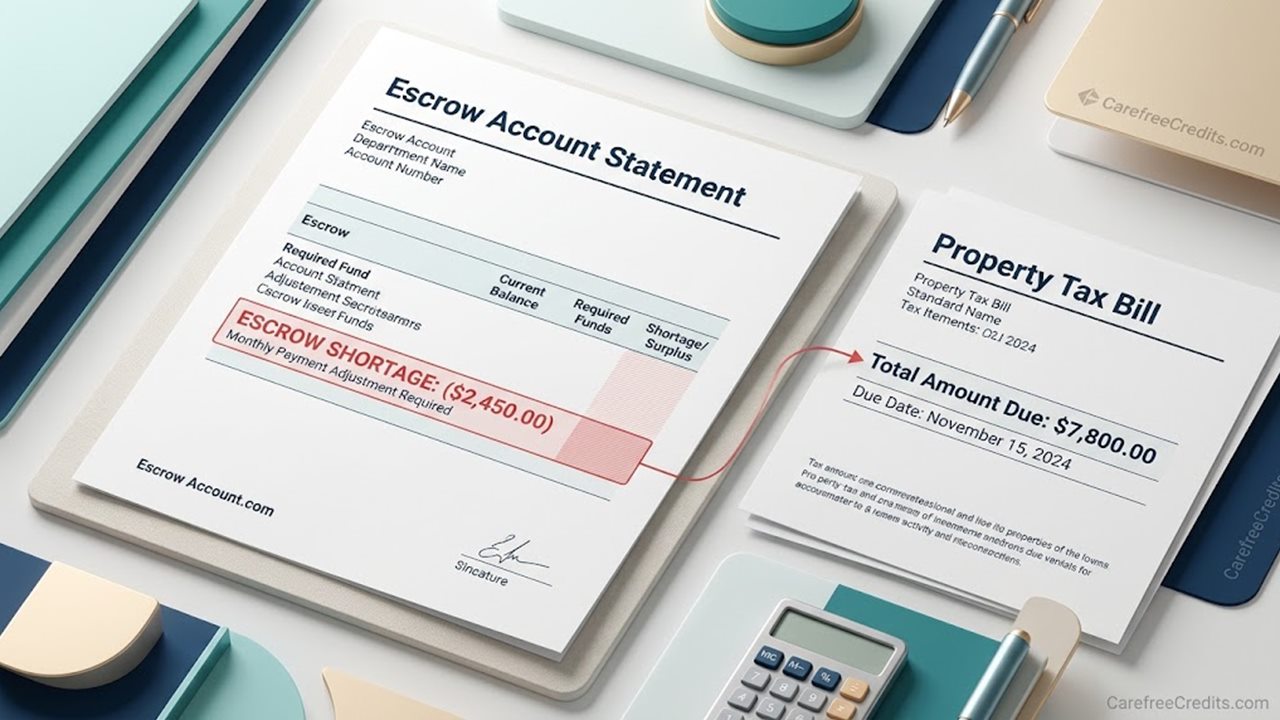
Last year your property tax was $4,800 and insurance $1,800: $6,600 a year, or $550 a month in escrow. This year the county reassessed your home to $5,400 in taxes and your insurer raised the premium to $2,100: $7,500 a year.
| Item | Monthly |
|---|---|
| Old escrow payment | $550 |
| New escrow for higher bills ($7,500 ÷ 12) | $625 |
| Shortage of $900 spread over 12 months | $75 |
| New escrow payment in year one | $700 |
The payment rises by $150 in the first year. If you pay the $900 shortage in a lump sum, it rises only by $75, to $625. The maximum cushion the servicer may hold for these bills is one-sixth of $7,500, or $1,250.
Should you pay the shortage in a lump sum?
- Pay it at once if you have cash beyond your emergency fund: the monthly payment stays lower and you avoid a second step-down next year.
- Spread it over 12 months if cash is tight. There is no interest charge on an escrow shortage.
Either way, the new base escrow amount reflects the higher bills going forward.
How to keep the next increase small
- Check the tax assessment when it arrives and appeal if comparable homes are valued lower. Ask about homestead, senior or veteran exemptions.
- Shop homeowners insurance each year and consider a higher deductible; tell the servicer about any new policy so it pays the right insurer.
- Review the escrow statement for errors such as a duplicate tax payment or a lapsed policy replaced by expensive force-placed insurance.
- Remove PMI once you reach 20% equity, if your loan has it; see how much house can I afford for how PMI affects the payment.
Can you drop escrow altogether?
Some conventional loans allow an escrow waiver if you have enough equity, often 20% or more, and a good payment record, sometimes for a fee. FHA and VA loans generally require escrow. Paying taxes and insurance yourself demands discipline, because missed tax bills can lead to liens.
Frequently asked questions
Why did my mortgage payment go up with a fixed rate?
Because the escrow part rose. Fixed-rate loans fix principal and interest, but property taxes and insurance can change every year.
Can my servicer require me to repay a shortage immediately?
Only if the shortage is less than one month's escrow payment. Larger shortages must be allowed to stand or spread over at least 12 months.
How large can the escrow cushion be?
Up to one-sixth of the estimated annual disbursements, about two months, unless your mortgage documents or state law set a lower amount.
Will I get money back if I overpaid?
Yes. If the analysis shows a surplus of $50 or more and you are current, the servicer must refund it within 30 days.
Does an escrow shortage hurt my credit?
No, as long as you make the required payments. Missed mortgage payments would be reported.