Getting a Mortgage When You're Self-Employed: Tax Returns, Income Math and Options
How lenders calculate qualifying income for freelancers, gig workers and business owners, why deductions can shrink your loan, the one-year exception, bank statement loans and how to prepare.
Listen to this article
Key takeaways
- Conventional lenders usually want two years of personal (and business) tax returns; Fannie Mae may accept one year if the business has existed for at least five years.
- Qualifying income is generally your net self-employment income, averaged over two years if stable or rising.
- If income declined, lenders typically use the lower, more recent figure, or may question its stability.
- Bank statement loans exist for strong earners with heavy deductions, but cost more and need larger down payments.
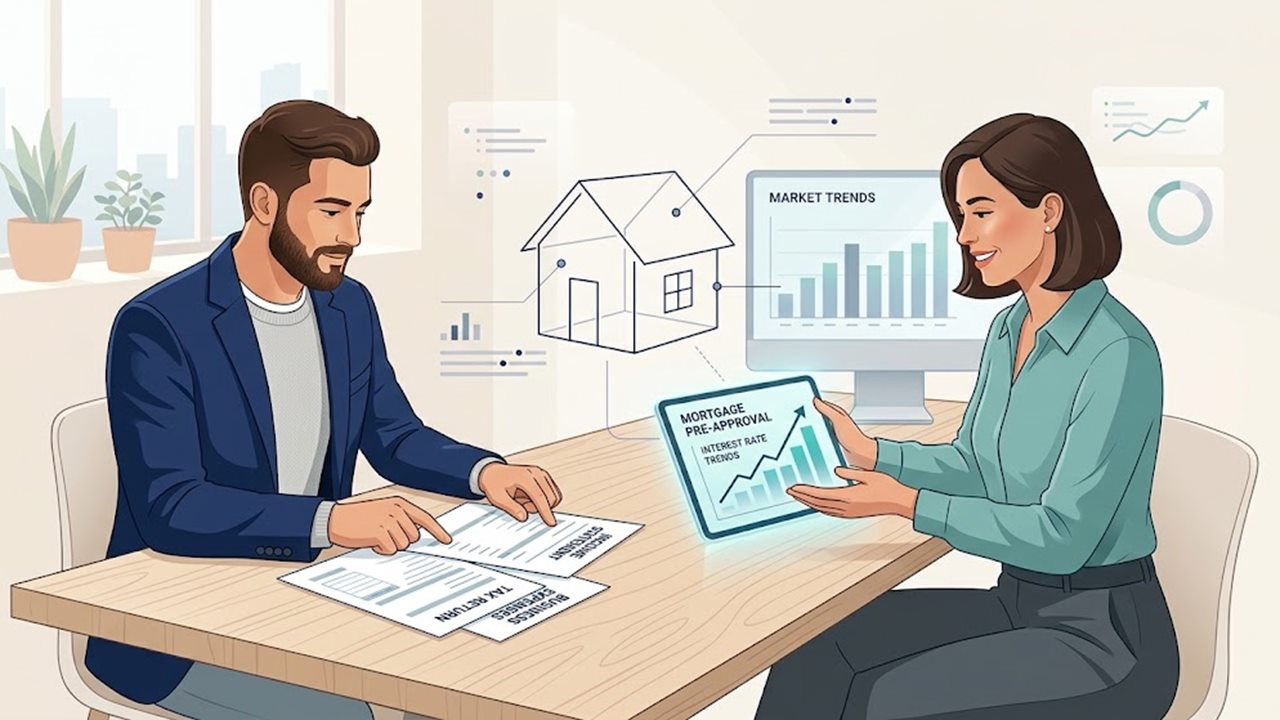
A self-employed borrower with $150,000 of revenue can look, on paper, like someone earning $60,000. Mortgage underwriting is built around what your tax returns show, which rewards preparation. If you plan to buy in the next year or two, the decisions you make with your tax preparer now affect how much you can borrow.
Please note
Based on common Fannie Mae and Freddie Mac guidelines as of October 2026; FHA, VA and non-QM lenders have their own rules, and lenders can be stricter. General information, not tax or lending advice.
Who counts as self-employed
Fannie Mae treats a borrower as self-employed if they have an ownership interest of 25% or more in a business. Independent contractors paid on Forms 1099-NEC or 1099-K, sole proprietors, partners and S-corporation owners all fall into this group. Lenders also look at whether you have been self-employed long enough to establish a pattern of income.
Documents you will need
- Personal tax returns (Form 1040 with all schedules) for the last two years, typically.
- Business returns (Form 1065, 1120-S or 1120) if you own a partnership or corporation, plus K-1s.
- Year-to-date profit-and-loss statement and recent business bank statements, depending on timing.
- Form 4506-C so the lender can verify the returns with IRS transcripts.
Fannie Mae's guidelines allow one year of returns in some cases, notably when the business has been in existence for at least five years and the automated underwriting system accepts it.
How lenders calculate your income
Underwriters start with net profit and add back certain non-cash or one-time deductions, typically depreciation, depletion, amortization and business use of the home, then subtract non-recurring income. Fannie Mae's Form 1084 is the standard worksheet.
| Scenario | Year 1 | Year 2 (latest) | Monthly qualifying income |
|---|---|---|---|
| Stable or rising income: average | $72,000 | $84,000 | $6,500 |
| Declining income: lower figure | $90,000 | $78,000 | $6,500 |
Two very different histories produce the same qualifying income here, which shows why trends matter. A significant decline may also require an explanation and evidence that income has stabilized.
The deduction trade-off
Every dollar of business expense you deduct lowers your tax but also lowers your qualifying income, unless it is one of the add-backs. A driver who claims a large mileage deduction, for example, shows lower net profit to the lender. Legitimate deductions should still be claimed, but if a purchase is planned, discuss with your tax preparer whether to accelerate or defer optional expenses, and never inflate income on a return. Our guide to 1099 taxes explains how net profit is built.
What else lenders look at
- Debt-to-income ratio: conventional loans commonly allow up to 45% to 50% with automated approval; see how much house can I afford.
- Reserves: cash left after closing; self-employed borrowers are often asked for more.
- Business health: lenders may review business liquidity if you draw income from business accounts.
- Credit score and down payment, as for any borrower.
Bank statement and other non-QM loans
Non-qualified mortgage (non-QM) lenders offer bank statement loans that estimate income from 12 or 24 months of deposits instead of tax returns. They can help borrowers whose returns understate cash flow, but expect higher rates than conventional loans, larger down payments (often 10% to 20% or more) and fewer consumer protections. Compare the total cost carefully before choosing one.
A preparation checklist
- File both years' returns on time, with all schedules, and keep copies.
- Keep business and personal finances in separate accounts.
- Avoid large new debts and unexplained deposits in the months before applying.
- Prepare a year-to-date profit-and-loss statement.
- Build reserves, ideally several months of payments, in addition to the down payment.
- Get preapproved early so the lender can flag issues while there is time to fix them.
Frequently asked questions
Can I get a mortgage with one year of self-employment?
Sometimes. Fannie Mae can accept one year of returns in specific cases, such as an established business of five years or more, and some lenders accept a shorter history if you worked in the same field as an employee.
Do lenders use gross or net income for self-employed borrowers?
Net income from your tax returns, with certain add-backs such as depreciation, not gross revenue.
Can I use a 1099 instead of tax returns?
Most conventional lenders want the tax returns, because 1099s show gross payments before expenses. Some non-QM programs work with 1099s or bank statements.
Are mortgage rates higher for self-employed borrowers?
Not on conventional, FHA or VA loans with full documentation: pricing depends on credit, down payment and loan type. Alternative-documentation loans do cost more.
Should I take fewer deductions to qualify?
Discuss it with a tax professional. Skipping legitimate deductions raises your tax bill; the trade-off only makes sense if it materially changes your loan options.