Personal Loans for Self-Employed and 1099 Workers: How Lenders Verify Income
Which documents lenders ask freelancers, gig workers and sole proprietors for, why net profit matters more than gross income, and how to strengthen an application before you apply.

Listen to this article
Key takeaways
- Lenders usually ask for your last one or two federal tax returns (with Schedule C), recent bank statements and sometimes your 1099 forms.
- Qualifying income is generally your net profit after business expenses, not your gross receipts.
- Large deductions lower your tax and also your borrowing power.
- Lenders may verify returns directly with the IRS using a signed Form 4506-C.
A salaried applicant proves income with two pay stubs. A freelancer, rideshare driver or consultant has no pay stub and income that rises and falls. Lenders handle this by looking backwards at what your business actually earned. Knowing how they read your numbers lets you prepare an application that reflects your real ability to repay.
Please note
General information as of October 2026. Lenders set their own documentation and underwriting rules, so requirements vary from one lender to the next.
What counts as self-employed
For lenders, you are self-employed if you are paid as an independent contractor (Forms 1099-NEC or 1099-K), run a sole proprietorship or own a meaningful share of a business. If you also have a W-2 job, most lenders evaluate both income streams separately and add them up.
The documents lenders typically ask for
| Document | What the lender learns |
|---|---|
| Form 1040 with Schedule C (1 to 2 years) | Net profit, trend and stability of income |
| Bank statements (often 2 to 12 months) | Current cash flow and whether deposits match the returns |
| Forms 1099-NEC / 1099-K | Who pays you and how much |
| Profit-and-loss statement for the current year | Whether income is holding up since the last return |
| Form 4506-C (signed) | Permission to obtain IRS transcripts that confirm the returns |
Some lenders only need recent bank statements for smaller amounts. Others, especially banks, want two years of returns. Ask before applying so you can gather everything at once.
Why net profit is your income
Lenders care about what is left to repay a loan after your business pays its own costs. That is your net profit on Schedule C (line 31), which already reflects deductions such as mileage, equipment, software and a home office.
Example
A rideshare driver reports $52,000 in gross receipts, $12,000 in platform fees and $14,000 in mileage and other expenses. Net profit is $26,000, or about $2,167 a month. With $400 of existing debt payments and a new $350 loan payment, the debt-to-income ratio is about 35%. Using the $52,000 gross figure would have suggested half that ratio, but lenders will not use it.
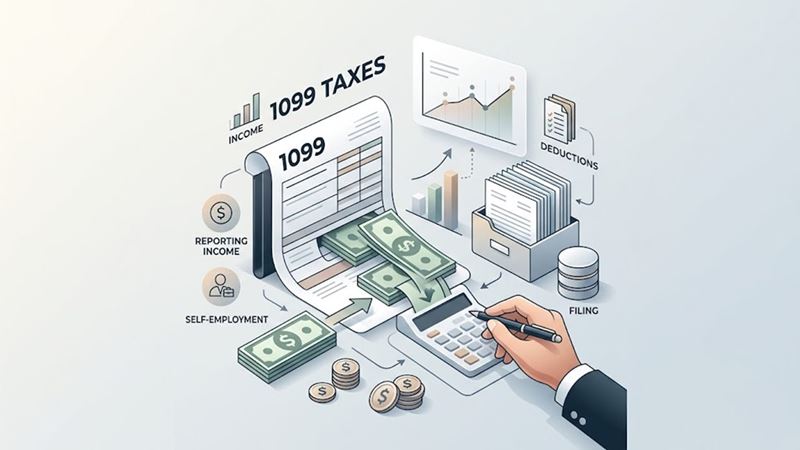
This creates a trade-off. Every legitimate deduction lowers your tax, but it also lowers the income a lender sees. If you plan to borrow, avoid claiming expenses you cannot document, and talk to your tax preparer about timing major purchases. Our 1099 tax guide explains how profit is calculated.
How lenders handle uneven income
- Averaging: with two years of returns, many lenders average the net profit.
- Declining income: if the latest year is lower, lenders often use the lower figure or ask for an explanation.
- Short history: less than two years of self-employment can be a hurdle; a strong prior record in the same line of work helps.
- Seasonality: bank statements covering a full year show how income evens out.
How to strengthen your application
- File your taxes on time and keep copies of every schedule. Lenders cannot use income you have not reported.
- Separate business and personal accounts, so deposits clearly show business income.
- Prepare a simple year-to-date profit-and-loss statement.
- Lower your debt-to-income ratio by paying down card balances before applying.
- Check your credit and prequalify with several lenders, including your bank and a credit union.
- Keep your tax reserve separate, so a lender sees it is not spending money. See where self-employed people should keep their tax money.
Loan options worth comparing
- Unsecured personal loans from banks, credit unions and online lenders, priced mainly by credit score and DTI. Current levels in average personal loan rates.
- Secured loans backed by savings, which can be easier to get with uneven income.
- Business credit, such as a business credit card or a small business loan, if the money is for the business. Business borrowing keeps expenses separate, and business interest is generally deductible on Schedule C.
Frequently asked questions
Can I get a personal loan if I am self-employed?
Yes. Lenders lend to self-employed people regularly, but they document income through tax returns and bank statements instead of pay stubs.
Do lenders use gross or net income for 1099 workers?
Generally net income after business expenses, as shown on Schedule C.
How many years of self-employment do I need?
Many lenders prefer two years. Some approve with one year of returns or with bank statements, often at a higher rate.
Can I use bank statements instead of tax returns?
Some lenders accept bank statements for smaller loans or as a supplement. Most mainstream lenders still want at least one tax return.
Is interest on a personal loan deductible for the self-employed?
Only the share used for business purposes, which is deducted as business interest. Read is personal loan interest tax deductible?