How to Get a Personal Loan: 7 Steps to the Best Offer
From checking your credit and prequalifying with a soft pull to comparing APRs, origination fees and lenders, what documents you need, how long funding takes and how to avoid common traps.
Listen to this article
Key takeaways
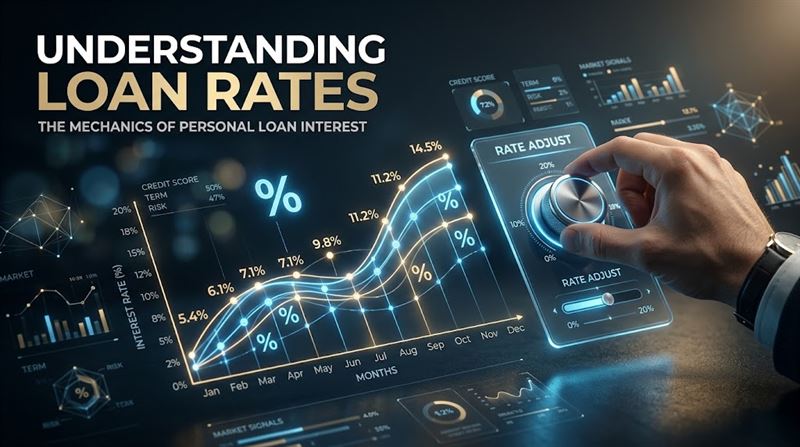
- Commercial banks charged an average of 11.86% on 24-month personal loans in the Federal Reserve's latest quarterly data; online offers range from about 6% to 36%.
- Prequalify with three to five lenders. Prequalification uses a soft pull and does not affect your score.
- Compare the APR, which includes origination fees. A 12% loan with a 5% fee costs more than a 14% loan with no fee.
- Approval often takes minutes to a few days, and many lenders fund within one to five business days.
A personal loan gives you a lump sum with a fixed rate, a fixed monthly payment and a fixed end date. That makes it useful for consolidating card debt, paying for a large repair or covering a planned expense without putting it on a 22% credit card. The process is simple, but the price varies widely between lenders, so most of the savings come from comparing offers properly.
Step 1: Decide how much and how long
Borrow only what you need. Longer terms lower the monthly payment but raise the total interest. Before applying, calculate a payment that fits your budget, and remember that many lenders cap your total debt payments at a certain share of income; see debt-to-income ratio.
Step 2: Check your credit
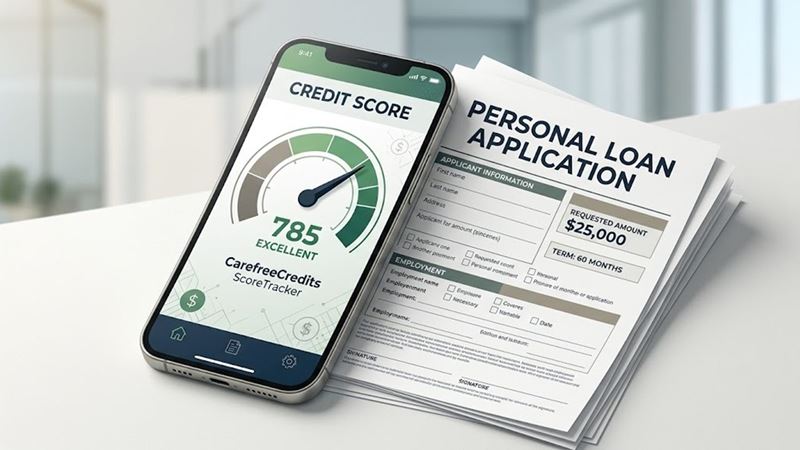
Your score has the biggest influence on your rate. Pull your free reports at AnnualCreditReport.com and fix any errors first. If your score is close to a threshold such as 670 or 740, paying card balances down for a month or two can move you into a better pricing tier. The ranges lenders use are explained in what credit score you need for a personal loan.
Step 3: Prequalify with several lenders
Banks, credit unions and online lenders let you see estimated rates with a soft credit check. Compare at least three. Credit unions are often cheaper for members, and federal credit unions cannot charge more than 18% APR on most loans; see bank vs. credit union.
Step 4: Compare APR, not just the rate
Many lenders deduct an origination fee from the loan amount. The APR includes it, so it is the right number to compare.
| $10,000 over 36 months | Offer A | Offer B |
|---|---|---|
| Interest rate | 12.00% | 14.00% |
| Origination fee | 5% ($500) | None |
| Cash you receive | $9,500 | $10,000 |
| Monthly payment | $332.14 | $341.78 |
| APR | 15.61% | 14.00% |
| Total cost (interest + fee) | $2,457 | $2,304 |
Offer A looks cheaper but costs more, and you receive $500 less. If you need the full $10,000 in hand, you would have to borrow more with Offer A. More on pricing in average personal loan rates.
Step 5: Gather your documents
- Government-issued photo ID and Social Security number or ITIN
- Proof of income: recent pay stubs, W-2s or, if self-employed, tax returns and 1099s
- Proof of address
- Bank account details for funding and autopay
- Information on debts to be paid off, if consolidating
Self-employed borrowers usually need two years of returns; see personal loans for the self-employed.
Step 6: Apply and review the agreement
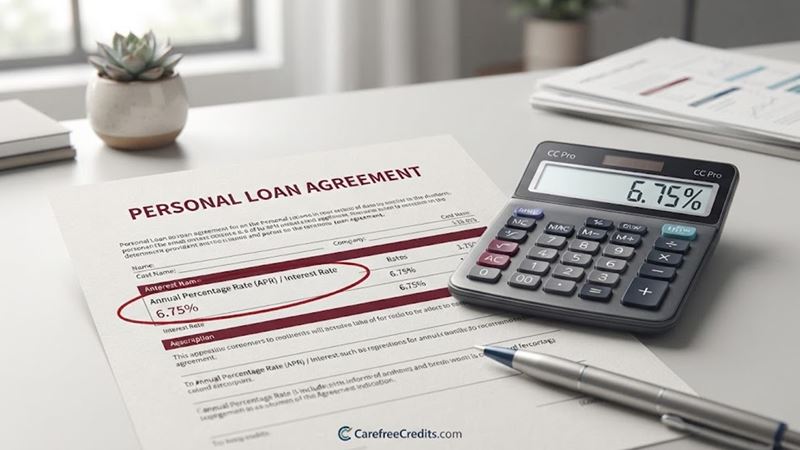
The formal application triggers a hard inquiry. Before you sign, check the APR, the payment, any prepayment penalty (most personal loans have none), late fees and whether the lender pays your card issuers directly for consolidation. Read whether the interest is calculated simply on the balance; avoid loans that use precomputed interest, see Rule of 78 loans.
Step 7: Set up autopay
Many lenders lower the rate by about 0.25 to 0.50 percentage point for automatic payments. More importantly, autopay prevents late payments, which hurt your credit for seven years.
Traps to avoid
- Upfront fees before approval are a classic loan scam. Legitimate lenders deduct fees from the loan or add them to it.
- Optional add-ons such as credit insurance raise the cost and are rarely worth it.
- "Guaranteed approval" ads usually mean very high APRs. For small emergencies, credit union payday alternative loans are far cheaper.
- Running up the cards again after consolidation leaves you with both debts.
Frequently asked questions
How fast can I get a personal loan?
Online lenders often approve the same day and fund within one to five business days. Banks and credit unions can take a little longer, especially for new customers.
Does prequalifying hurt my credit?
No. Prequalification uses a soft inquiry. The hard inquiry happens only when you submit a full application.
What is the easiest personal loan to get?
Secured loans, such as share-secured loans at a credit union, and loans with a cosigner are easiest to qualify for. Without either, expect higher rates if your credit is fair or poor.
Can I pay off a personal loan early?
Most lenders allow it without a penalty, which saves interest. Check the agreement for prepayment fees.
Is personal loan interest tax deductible?
Generally not, unless the money is used for business or certain investments; see is personal loan interest tax deductible.