Loan Calculator: Monthly Payment, Total Interest and Amortization
Calculate the monthly payment on a personal, auto or other fixed-rate loan, see the total interest, the APR including an origination fee, how extra payments shorten the loan and a full month-by-month amortization schedule you can download.
Listen to this article
This loan calculator works for any fixed-rate installment loan with equal monthly payments: personal loans, auto loans, student loans, boat or RV loans and home equity loans. It shows the payment, the true cost of the loan including fees and a complete amortization schedule. For a home purchase with property tax, insurance and PMI, use the mortgage calculator instead.
Loan calculator
Fixed-rate loan with equal monthly payments and interest at rate / 12 on the remaining balance. The APR with a fee uses the actuarial method of Regulation Z for level monthly payments. The first payment is assumed one month from now. Your lender's figures can differ by a few cents because of rounding.
Key takeaways
- A $20,000 loan at 11.86% for 60 months costs $443.48 a month and $6,608.52 in total interest.
- Adding $100 a month pays it off in 46 months and saves about $1,625 in interest.
- A 5% origination fee taken from the loan raises the APR on the same loan from 11.86% to about 14.14%.
- A longer term lowers the payment but raises the total interest; compare the total cost, not just the payment.
How the monthly payment is calculated
Fixed-rate loans are amortized: every payment is the same, but the share going to interest falls over time while the share going to principal rises.
Payment = P × r ÷ (1 − (1 + r)−n)
P is the loan amount, r the monthly rate (annual rate ÷ 12) and n the number of payments. Each month the interest is the remaining balance × r, and the rest of the payment reduces the balance. The 11.86% default is the Federal Reserve's average rate on 24-month personal loans at commercial banks in its quarterly consumer credit data; your offer depends on your credit, income and the lender.
Example: $20,000 at 11.86%
| Term | Monthly payment | Total interest | Total paid |
|---|---|---|---|
| 36 months | $662.95 | $3,866.19 | $23,866.19 |
| 48 months | $525.30 | $5,214.54 | $25,214.54 |
| 60 months | $443.48 | $6,608.52 | $26,608.52 |
| 72 months | $389.55 | $8,047.55 | $28,047.55 |
Stretching the loan from 36 to 72 months cuts the payment by about $273 but more than doubles the interest. Lenders often charge higher rates on longer terms as well, which widens the gap further.
APR vs. interest rate
The interest rate is what you pay on the balance. The annual percentage rate (APR) also includes finance charges such as an origination fee, so it is the better number for comparing offers. Under the federal Truth in Lending Act, lenders must disclose the APR before you sign. If a lender keeps a 5% fee from a $20,000 loan, you receive $19,000 but still repay $443.48 a month for 60 months, an APR of about 14.14%. Enter the fee in the calculator to see the APR of your offer, and read more in how personal loan interest rates work.
Paying a loan off early
Every extra dollar goes straight to principal, so it saves the interest that dollar would have cost for the rest of the term. On the example loan, $100 extra a month finishes 14 months early. Before paying extra, check that your loan has no prepayment penalty and that the lender applies extra money to principal, not to future payments. Loans with precomputed interest work differently; see Rule of 78 loans.
Reading the amortization schedule
The schedule under the results shows each year's payments, principal, interest and remaining balance; the PDF and CSV downloads include every single month. Early payments are mostly interest: in the first month of the example, $197.67 of the $443.48 payment is interest. By the last year, interest is only a small part of each payment. That is why refinancing or extra payments help most early in a loan.
Before you borrow
- Prequalify with several lenders using soft credit checks and compare APRs; see how to get a personal loan.
- Keep total debt payments in a range lenders accept; see the debt-to-income ratio guide.
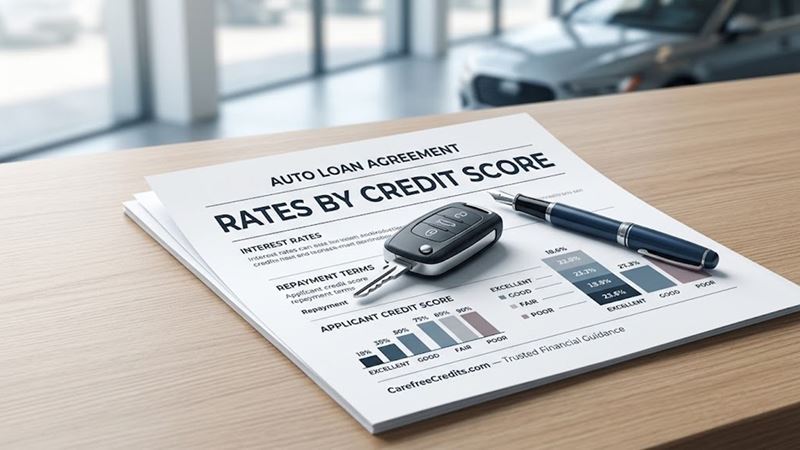
- For a car, compare dealer financing with a credit union and check auto loan rates by credit score.
Frequently asked questions
How do I calculate a loan payment?
Use the formula P × r ÷ (1 − (1 + r)^−n) with the monthly rate r and the number of payments n, or enter the amount, rate and term in the calculator above.
Does this calculator work for car loans?
Yes. Enter the amount you finance after the down payment and any trade-in, the APR and the term in months.
Why is my lender's payment slightly different?
Lenders may round each payment, count interest by days or adjust the last payment. Differences of a few cents or dollars are normal.
Is a lower payment always better?
No. A lower payment from a longer term usually means much more interest. Choose the shortest term whose payment fits comfortably in your budget.
Can I download the amortization schedule?
Yes. Use "Download CSV" for a spreadsheet with every month or "Download PDF" for a printable report.